

click below to login to your secure account
By
Tom Kozlik
Head of Public Policy and Municipal Strategy
Hilltop Securities Inc.
The way money and investments are handled is changing again. The next phase of money is likely to arrive “gradually, then suddenly.” In this context, Hemingway is worth borrowing. Major changes are often invisible while they are occurring and become obvious only at the point of inflection.
The “gradual” phase is underway now. The infrastructure, or “rails,” for digital money is advancing and perhaps accelerating. Some of the world’s largest financial institutions are building systems, making acquisitions, and dedicating resources to support a different transaction and settlement environment. Usage remains very narrow. Stablecoins, tokenization, and blockchain-based systems operate in defined lanes but have not yet spread across the broader financial ecosystem.
Market structure changes rarely announce themselves on a specific day. What appears “suddenly” is often the product of years of quiet change and back-office preparation. New payment rails, tokenized funds, digital custody platforms, and other forms of financial infrastructure are taking shape today, often outside the attention of broader market participants. If, or when tokenization becomes a meaningful part of financial markets, it will not be because of a single participant, breakthrough or headline. It will be because years of incremental adoption finally reached a tipping point.
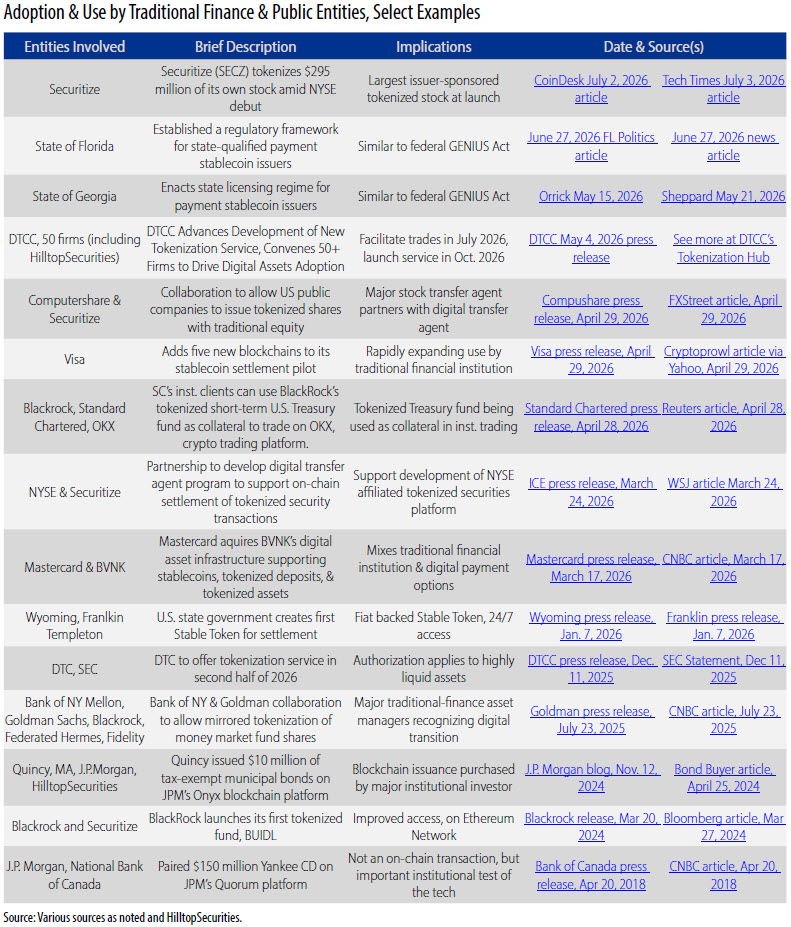
The most important development may not even be adoption itself, but institutional preparation. End-user demand remains limited, yet many financial institutions are acting as though a different financial architecture is likely to emerge. Traditional finance (tradfi) and financial technology (fintech) are increasingly converging. Whether that preparation ultimately proves premature or clairvoyant remains an open question, but the groundwork is already being laid. (Please see our table “Adoption & Use by Traditional & Public Entities” on page 7 for a summary of selected activity and acquisitions).
The better way to understand this moment in the next phase of money is not necessarily through institutional acquisitions or the novelty of what the new technology promises. It is through the constraints that money and transactions may soon run up against, and how money has changed over time when it ran into similar constraints in the past. The penny’s retirement is a small but telling example. It costs more to produce than it is worth, and transactions are already adjusting through rounding. The unit failed the system, and the system is adjusting. Sometimes the system changes the unit. Sometimes the system changes the rails.
Money does not evolve just because new technology is faster or more secure. Money transitions when the system no longer satisfies how value needs to move and how people and institutions transact. It evolves when the existing structure itself becomes the limitation. That pattern is consistent over millennia, not just centuries. Barter worked in small communities, but it broke down as trade widened and specialization increased. Commodity money gave societies a shared reference point for value, but it created new costs around storage, transport, and verification. Coinage simplified exchange. Paper claims allowed larger amounts of value to move without the asset. Modern finance and modern payment rails then accelerated moving trusted value faster across distance and time.
Each step addressed a specific constraint, and each required new rules, infrastructure, and in some cases new rails to maintain trust as the system expanded. The current transition follows the same structure, but it has not reached its breaking point. In fact, we are probably still very early on in the “gradual” phase of the transition.
Most individuals, customers, institutions, or governments do not need a new way to make a payment, close a transaction, or settle one. Most would report not only that they have a system that works, but even electronic adoption, much less digital adoption seems to be farther away than most think. Some may be surprised to find that a 2025 Association for Financial Professionals survey found that 75% of respondents have no plans to eliminate the use of paper checks in the next two years. There are some advantages to checks, according to some users.
Therefore, it is unlikely that only demand for a new way to make payments is going to be the catalyst that blends stablecoins, tokenization, and blockchain with traditional finance. For most individuals, governments and companies the need is not there yet, and the rails they are currently using are satisfactory, and in some cases preferable. Where the technology-driven transition could gain traction is where settlement is concerned. Larger multi-national corporations, financial institutions, and even some governments at some point could be faced with regular issues where they are trying to acquire the ability to move money globally, continuously (24/7 even), and securely.
The financial system still lacks an always-on, global settlement method that is reliable in practice. This shortcoming matters more each year as commerce becomes more real-time and occurs more often across international borders. Shahmir Khalip Citigroup’s Global Head of Services framed the settlement or client problem this way.
“The real client problem that we are looking to solve is the ability for large multi-nationals, big banks, and broker-dealers and fintechs to be able to move their money around, make payments seamlessly around the world 24/7.”
Stablecoins can be part of the answer. A stablecoin is a digital asset designed for payment or settlement that aims to maintain a stable value relative to a fixed monetary amount, typically one U.S. dollar. The appeal is speed and flexibility, including the ability to move settlement cash outside traditional banking hours. Its risk lies in the fact that stability depends entirely on reserve backing, legal structure, operational controls, and the issuer’s ability to meet redemptions during times of moderate to severe market stress, or even dislocation.
These risks are a key reason why the evolving regulatory landscape is important. The GENIUS Act of 2025, signed into law on July 18, 2025, created a federal framework for stablecoins and set baseline expectations around reserves, redemption, disclosure, and risk controls.
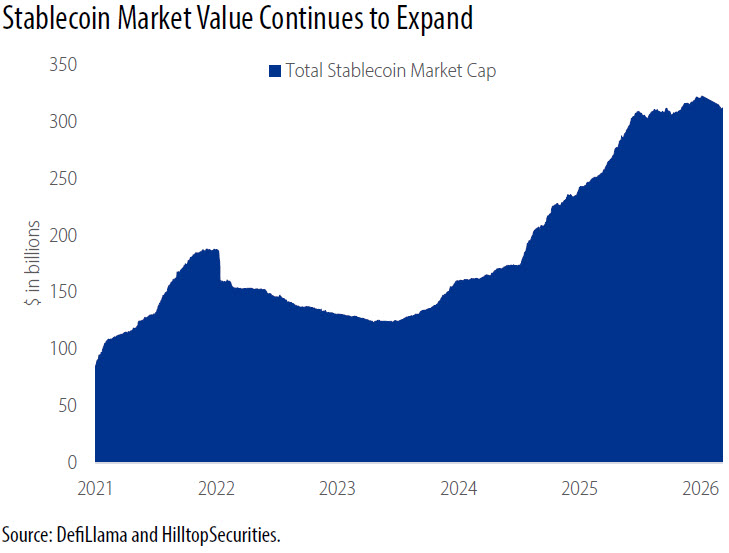
Under the GENIUS framework, stablecoins are not federally insured and issuers are prohibited from paying interest to holders, which pushes stablecoins toward a narrow settlement utility and keeps the yield question at the center of implementation and market structure debates. Other disruptions are likely to evolve with their potential utilization as well. Regulators are now implementing this framework through new operating rules. The OCC issued a proposed rule in February 2026 aimed at national banks and other entities under its jurisdiction, and the FDIC approved a proposed rule in April 2026 for FDIC-supervised entities.
A COMPARISON: A stablecoin functions like digital cash. It is designed to maintain a stable value, usually tied to the U.S. dollar, and is intended for everyday transactions. Bitcoin, by contrast, is a decentralized digital asset with a market-driven price that can be highly volatile. Bitcoin is more commonly viewed as an investment or store of value rather than a transactional instrument.
Public finance leaders approach cash and liquidity instruments with deliberate fiscal conservatism, and for good reason. Elected and appointed officials, along with their fiduciaries, are accountable not only to markets, but to taxpayers, ratepayers, and the broader public. Legal and policy constraints on permitted investments are strict and often narrow by design. A conservative approach is typically a governance requirement.
That discipline often defines how new financial technologies can enter public finance. Typically, adoption occurs slowly, with much consideration for the potential for negative disruption. Adoption starts with prioritizing reliability, legal clarity, and operational control, not novelty or even speed. Technologies that succeed elsewhere by moving fast or staying flexible face a higher bar in public finance. New technologies and firms that try to introduce them must operate within narrow investment rules, withstand layered oversight, and perform predictably under stress. For that reason, digital money will enter public finance more slowly and under stricter conditions, not because the sector resists change, but because public finance leaders must protect the public’s trust and the public’s funds.
Wyoming introduced its Frontier Stable Token at the beginning of this year. Other states, including Florida and Georgia recently created legislation similar to the federal GENIUS Act to move forward on this path as well.
Tokenization and blockchain can also be considered part of the solution to the client problem institutions are trying to solve. Tokenization represents a bond or other financial instrument such as an equity or a fund share, as a digital token so ownership and transfers can be recorded and updated on a digital ledger. A blockchain is a shared recordkeeping system that allows authorized participants to maintain and view a common transaction and ownership record on a common network. We discussed the foundational concepts of blockchains in more detail in prior work in, Web3, Blockchain, and U.S. Public Finance where we went into even more detail about blockchain’s background and technology.
A small number of fintech firms have tried to modernize the U.S. municipal market over the last decade, with very limited results. Early efforts often matter less for their immediate success than the ground they clear for those who follow. Neighborly is an example. Neighborly talked openly about bringing tokenization and blockchain infrastructure into public finance back in 2017, and participated in only limited municipal activity, and then pivoted away before the COVID-19 pandemic.
Alphaledger is still best known in public finance for putting a limited number of municipal loan and bond records on a blockchain. In June 2025 Alphaledger and Moody’s Ratings completed a proof of concept that disseminated a municipal bond rating on the Solena blockchain, a milestone that helped to symbolize a connection between traditional public finance and fintech and blockchain technology. The company’s more recent trajectory has been toward broader, regulated tokenization infrastructure and on-chain securities products.
Municipals come with known but specific structural constraints compared to other markets. The municipal bond market is retail dependent, fragmented across tens of thousands of public entities, and governed by the overlap of various laws. Securities and Exchange Commission (SEC) Commissioner Hester Peirce made this point directly in January 2026. She called tokenization potentially transformative and cited possible benefits such as atomic settlement, extended hours trading, and easier collateralization, while also warning that wide-scale tokenization of municipal securities is not inevitable.
Dave Sanchez, Director of the SEC’s Office of Municipal Securities, delivered a complementary message during the same program. He said the market is on the precipice of major changes in how it operates and that tokenization, digital collateral, and atomic settlement are no longer just theories in some cases, while emphasizing that core regulatory concerns do not change. In other words, the new technology has the potential to change the workflow, but it does not change disclosure obligations, suitability, tax constraints, or other official requirements.
Quincy, MA is the clearest municipal use case so far. In April 2024, the City of Quincy issued about $10 million of tax-exempt municipal bonds using J.P. Morgan’s private, permissioned blockchain-based platform, with issuance, settlement, and ownership recording handled on that ledger. Later that year, BlackRock’s iShares Short Maturity Municipal Bond Active ETF bought about $6.5 million of the Quincy issue, putting one of the largest institutional buy-side names on a still-new market structure.
Wyoming’s Frontier Stable Token (FRNT) is a separate kind of public sector example. Wyoming describes the FRNT as a U.S. state-issued, fiat-backed stable token designed to be redeemable one-for-one for a U.S. dollar held in trust, backed by cash and short-duration U.S. Treasuries with a 2% overcollateralization target. Wyoming’s FRNT is likely meant to be a settlement tool, intended for operational workflows like vendor payments. It matters for public finance because this is a real test of the theory of 24/7, lower-friction settlement inside a public-sector governance framework. The current takeaway for the U.S. public finance sector is the precedent for the use of new institutional rails to support workflows, along with groundwork for clear legal & tax frameworks, and investor protections.
In public finance, any move toward digital assets or new technology will likely be approached with a conservative bias because protecting the public trust, safeguarding public funds, maintaining official records, and preserving investor protections are foundational. In the near term, the relevance is operational across the bond lifecycle, from issuance and closing to secondary trading and settlement. These issues deserve attention because the underlying financial infrastructure is already taking shape elsewhere, even if public finance adopts it more slowly and selectively.
The promise of this evolving technology is real, but so is the uncertainty about how quickly it is going to be adopted. Even sophisticated institutions disagree about which rails will ultimately prevail, which is typical in early transitions. That disagreement also implies adoption may not be linear. Adoption may occur slowly at first, even over the next several years, and then accelerate once use cases connect to mainstream assets and settlement systems and once standards and scale economies draw more institutions and users in.
What is becoming clearer is that stablecoins, tokenization, and blockchain are no longer speculative crypto‑market theories. They are being not only piloted but also adopted within traditional financial infrastructure. Stablecoin adoption is real but early. McKinsey, working with Artemis Analytics, estimates current stablecoin payments volume at roughly $390 billion annually, a fraction of global payments compared to Visa’s $14.2 trillion in fiscal year 2025. The transition is happening, however. This is the “gradually” part we wrote about in the opening when we cited Hemingway.
The Depository Trust & Clearing Corporation (DTCC) is facilitating limited trades of tokenized securities in July 2026, with plans to launch a more widespread service in October 2026. Visa is expanding its blockchain network, while market‑infrastructure firms such as the NYSE and Securitize are building operational rails to support on‑chain settlement and transfer‑agent functions. Tokenization is appearing in real workflows, including the collaboration between BNY Mellon and Goldman Sachs to mirror money‑market fund shares on‑chain. We summarize some additional adoption use cases in the table on the following page as well.
That real-world adoption activity matters, because we are likely watching the “fintech” label dissolve into the plumbing of traditional finance. Just as “online publishing” stopped being a category once it became publishing, fintech is being absorbed into the plumbing of traditional finance. Stablecoins, tokenization, and blockchain are moving out of the fintech bucket and into operational market infrastructure.
The digital money infrastructure for the next phase of money is being built, and institutional credibility is steadily accumulating. The everyday economy, and public finance in particular, are not yet operating on these rails. But history shows that money transitions gradually, not all at once. This next phase has already begun. As it continues to take shape across other parts of finance, public finance, guided by its responsibility to protect the public trust and public funds, is unlikely to remain far behind.
Readers may view all of the HilltopSecurities Municipal Commentary here.
 As Head of Public Policy and Municipal Strategy, Tom Kozlik advises HilltopSecurities’ businesses and clients on strategies related to U.S. public policy, public finance, and infrastructure. He publishes regular commentary that provides insight into current trends affecting these themes across a variety of sectors and geographic regions. Kozlik is frequently featured in print, digital, and broadcast news segments and regularly offers his expertise as a keynote speaker and panelist at industry conferences and events across the country. He can be reached at 214.859.9439 or tom.kozlik@hilltopsecurities.com.
The paper/commentary was prepared by HilltopSecurities (HTS). It is intended for informational purposes only and does not constitute legal or investment advice, nor is it an offer or a solicitation of an offer to buy or sell any investment or other specific product. Information provided in this paper was obtained from sources that are believed to be reliable; however, it is not guaranteed to be correct, complete, or current, and is not intended to imply or establish standards of care applicable to any attorney or advisor in any particular circumstances. The statements within constitute the views of HTS Public Finance as of the date of the document and may differ from the views of other divisions/departments of Hilltop Securities Inc. In addition, the views are subject to change without notice. This paper represents historical information only and is not an indication of future performance. This material has not been prepared in accordance with the guidelines or requirements to promote investment research, it is not a research report and is not intended as such. Sources available upon request.
Hilltop Securities Inc. is a registered broker-dealer, registered investment adviser and municipal advisor firm that does not provide tax or legal advice. HTS is a wholly owned subsidiary of Hilltop Holdings, Inc. (NYSE: HTH) located at 717 N. Harwood St., Suite 3400, Dallas, Texas 75201, (214) 859-1800, 833-4HILLTOP.