

click below to login to your secure account
By Matt Harris, CFA
Senior Portfolio Advisor
HilltopSecurities Asset Management
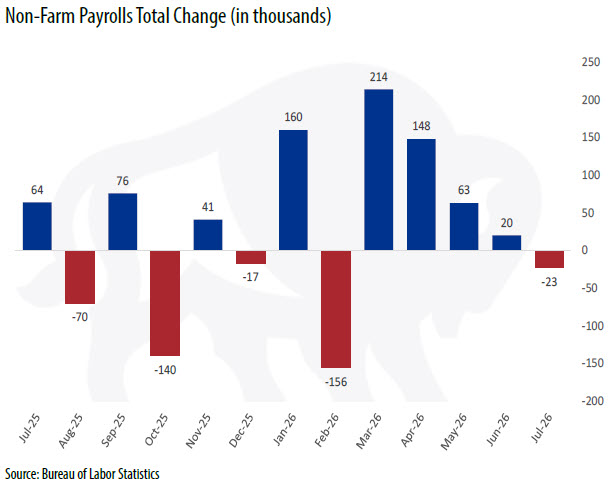
US businesses shed -23k jobs in July, falling well below estimates of +80k. In fact, not one economist ahead of the release projected payroll growth below +40k, making the negative headline a surprising miss. The report was further weakened by a combined 103k downward revision to the prior two months. This brings the three-month average payroll gains down to only 20k jobs from 111k previously.
At this point, payroll growth has slipped below the estimated breakeven pace of approximately 50k necessary to absorb new entrants into the labor force. Earlier this week, the ADP employment report also pointed to a cooling labor market after posting its weakest reading of the year and coming in at 44k, below expectations.
Job losses were concentrated in a handful of sectors. Leisure and hospitality fell by 40k, while government payrolls declined by 53k. The decline in leisure employment was surprising given the conclusion of the World Cup. Government employment may have been affected by seasonal adjustments surrounding staffing and the start of the new school year. Retail employment also weakened, declining by 19k jobs during the month. On the positive side, construction payrolls increased by 22k and manufacturing added 5k jobs, indicating portions of the economy are benefiting from ongoing investment and infrastructure development.
Wage growth was slower for the month. Average hourly earnings rose only 0.1% during the month, causing the year-over-year increase to slow to 3.2% from 3.5% previously. The average workweek held steady at 34.3 hours while aggregate hours worked were unchanged during the month.
In the separate household survey, both employment and unemployment declined during July. The number of employed Americans fell by 87k while the number of unemployed individuals declined by 178k, resulting in a contraction of approximately 264k people in the labor force. As a result, the unemployment rate edged down to 4.1%.
At first glance, a lower unemployment rate would typically suggest improving labor market conditions. However, the decline was largely driven by the shrinking labor force rather than stronger hiring. The labor force participation rate fell to its lowest level since February 2021, continuing a downward trend associated with an aging workforce and slower hiring activity. The employment-to-population ratio has also declined from 59.7% at the end of last year to 58.9% today. With fewer individuals working or actively seeking employment, labor market conditions appear softer than the headline unemployment rate would suggest.
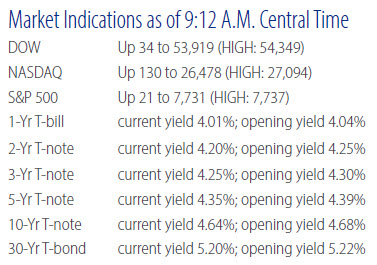
Bond yields moved lower following the release as the market reassesses the likelihood of further Fed tightening. Treasury yields declined across much of the curve while equity markets also traded higher as investors viewed the softer labor data as reducing pressure on the Fed to maintain a hawkish policy stance.
Interest rate futures also shifted following the release. Markets now assign a 45% probability of a rate increase at the September FOMC meeting, down from around 60% before the report. While markets still anticipate one rate increase before year-end, today’s data lowers concerns that the Fed may need to maintain a more aggressive policy stance.
Attention now turns to next week’s July inflation reports, which may prove more important for monetary policy expectations. With payroll growth slowing, labor-force participation declining, and wage pressures moderating, investors will be looking to see whether inflation moves lower as well. A soft CPI report would likely reinforce the view that the Federal Reserve can move further away from its recent hawkish bias, while another upside inflation surprise could keep the possibility of further policy tightening on the table.
About Scott McIntyre, CFA
 As HilltopSecurities Asset Management’s Co-Head of Investment Management, Scott McIntyre specializes in investment management services and is responsible for the management, oversight and trade supervision of more than $30 billion in institutional fixed income assets for HilltopSecurities’ public sector municipal clients. Scott also provides investment advice and consulting, reviews local government investment policies, formulates overall investment strategies, evaluates account performance and oversees the day-to-day operations. He is a member of the Chartered Financial Analyst (CFA) Institute and a CFA Charterholder, a two-term advisor to the GFOA Treasury and Investment Management (TIM) committee, a Registered Investment Advisor, and holds FINRA Series 7, 24, 63, and 65 licenses.
About Greg Warner, CTP
 As HilltopSecurities Asset Management’s Co-Head of Investment Management, Greg Warner specializes in investment management services and is responsible for the management and oversight of more than $30 billion in institutional fixed income assets for HilltopSecurities’ public sector municipal clients. Greg coordinates all client services and portfolio management duties, including security evaluation and portfolio analysis, trading, investment reporting, board presentations, and monitoring of broker-dealer relationships. He is an advisory committee member to the Texas Association of Counties, a member of the Government Treasurers’ Organization of Texas (GTOT), a Registered Investment Advisor, a Certified Treasury Professional (CTP) and holds FINRA Series 7, 63, and 65 licenses.
About Matt Harris, CFA
 As HilltopSecurities Asset Management’s Senior Portfolio Advisor, Matt Harris specializes in investment management services for public sector municipal clients. He developed his experience in the banking industry, supporting balance sheet management, interest rate risk analysis, liquidity planning, and investment strategy implementation. At HilltopSecurities, he works closely with clients to develop and implement customized investment strategies, oversees account documentation and reporting, and assists clients with the public funds depository review process, including competitive RFP evaluations. Harris is a member of the CFA Institute and a CFA Charterholder, a Registered Investment Advisor, and holds FINRA Series 7, 63, and 66 licenses.
The paper/commentary was prepared by HilltopSecurities Asset Management (HSAM). It is intended for informational purposes only and does not constitute legal or investment advice, nor is it an offer or a solicitation of an offer to buy or sell any investment or other specific product. Information provided in this paper was obtained from sources that are believed to be reliable; however, it is not guaranteed to be correct, complete, or current, and is not intended to imply or establish standards of care applicable to any attorney or advisor in any particular circumstances. The statements within constitute the views of HTS and/or HSAM as of the date of the document and may differ from the views of other divisions/departments of Hilltop Securities Inc. and its affiliates. In addition, the views are subject to change without notice. This paper represents historical information only and is not an indication of future performance. Sources available upon request.
HilltopSecurities Asset Management is an SEC-registered investment advisor. Hilltop Securities Inc. is a registered broker-dealer, registered investment adviser and municipal advisor firm that does not provide tax or legal advice. HTS and HSAM are wholly owned subsidiaries of Hilltop Holdings, Inc. (NYSE: HTH) located at 717 N. Harwood St., Suite 3400, Dallas, Texas 75201, (214) 859-1800, 833-4HILLTOP.