

click below to login to your secure account
By
Tom Kozlik
Head of Public Policy and Municipal Strategy
Hilltop Securities Inc.
The U.S. economy remains resilient, and we expect the municipal market to remain as much of a viable and investable option for investors in the second half of 2026, as it was in the first. But the second half is still being shaped by a central constraint: inflation.
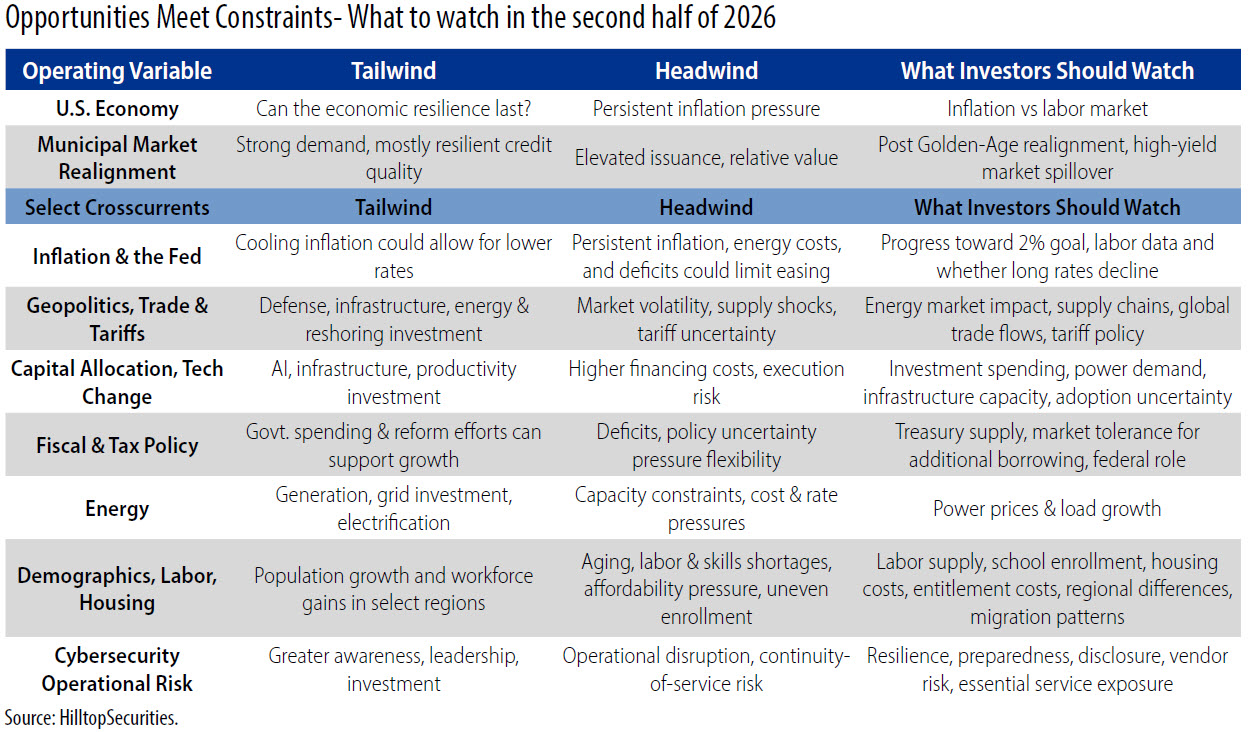
Nearly every major crosscurrent investors are watching, including geopolitics, capital allocation and fiscal policy, eventually runs through the cost of money. To paraphrase Warren Buffett from Alice Schroeder’s The Snowball: Warren Buffett and the Business of Life, interest rates are to finance what gravity is to physics. When inflation keeps interest rates higher for longer, it raises the weight on almost every decision investors, public entities and policymakers have to make.
Inflation has become and, in many cases, remains the common concern connecting public entities, municipal bond investors, households, executives, and financial market participants. Results from a June 2026 Gallup poll identify the high cost of living/inflation as Americans’ leading personal financial problem. A Bank of America global fund managers’ survey said 40% reported inflation as the No. 1 tail risk at the beginning of the summer. Inflation also moved back to the top of CFO’s list of most pressing business concerns in a poll conducted by the Richmond Federal Reserve Bank and Duke University.
Inflation is not the only story. Other crosscurrents matter, but inflation changes the terms of nearly all of them.
Higher borrowing costs and slowing economic growth could reduce public investment and challenge municipal bond credit quality. Labor shortages could keep service costs elevated. Rising and volatile energy prices can complicate the Federal Reserve’s path. Infrastructure-related constraints could limit potential future growth even if hyperscaler demand remains strong. Continued policy uncertainty could make capital investment more cautious at a time when the economy needs more of it. Parts of the economy are trying to break through, but inflation still sets the ceiling on how much room policymakers, investors and public finance entities have to maneuver.
The second half of 2026 began with a challenging but navigable combination of crosscurrents for investors, issuers and policymakers. The U.S. economy is still growing, but its strength is uneven. Economic activity has held up better than many expected. First quarter 2026 GDP was revised higher, to 2.1% from 1.6% in June. The Atlanta Fed’s latest “Nowcast” points to roughly 1.6% growth as of July 28, and the Bloomberg survey of economists expects growth of about 2.1% in the second quarter. Other economists expect second quarter growth to be roughly between 1.5% and 2.0%.
AI-related business investment is helping to hold up the headline number, similar to what happened in 2025. This has become an important support for the U.S. economy. Consumer activity is slowing, housing remains weak and trade is likely to subtract from second quarter GDP as imports tied to business investment and inventory needs run ahead of exports.
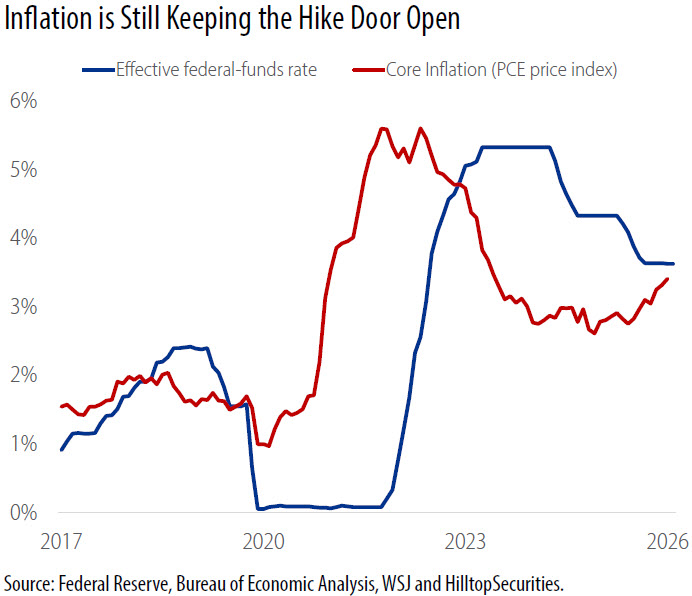
Inflation remains a constraint. The Federal Reserve left its target rate range unchanged at 3.50% to 3.75% at its July 29 meeting. The decision reinforced our view that inflation remains the defining constraint on the economy. While parts of the economy have cooled and labor market conditions have softened, inflation remains above the Fed’s comfort zone, prompting policymakers to keep rates on hold as they assess whether current policy is restrictive enough to restore price stability.
Three voting members favored an immediate rate hike, underscoring the extent to which inflation concerns continue to outweigh calls for easier monetary policy. Economists generally expected the Fed’s next move to be a rate cut, but persistent inflation pressures, rising oil prices, and the latest FOMC vote suggest the risk of higher-for-longer rates remains very much alive.
The data show why this is one of the Fed’s most difficult policy moments in years. Core inflation surged ahead of the Fed’s response in 2021 and 2022, forcing the federal-funds rate sharply higher and keeping policy restrictive even as inflation later cooled. Now, core inflation has moved back above 3% in 2026 while the policy rate remains elevated, keeping the risk of higher-for-longer policy alive.
The labor market gives the Fed another reason to move carefully. Again, core inflation has moved back above 3% in 2026, while unemployment is also sitting above the 4% line. That combination leaves the Fed with less room to treat inflation as yesterday’s problem, but also less freedom to tighten policy without considering the risk to growth.
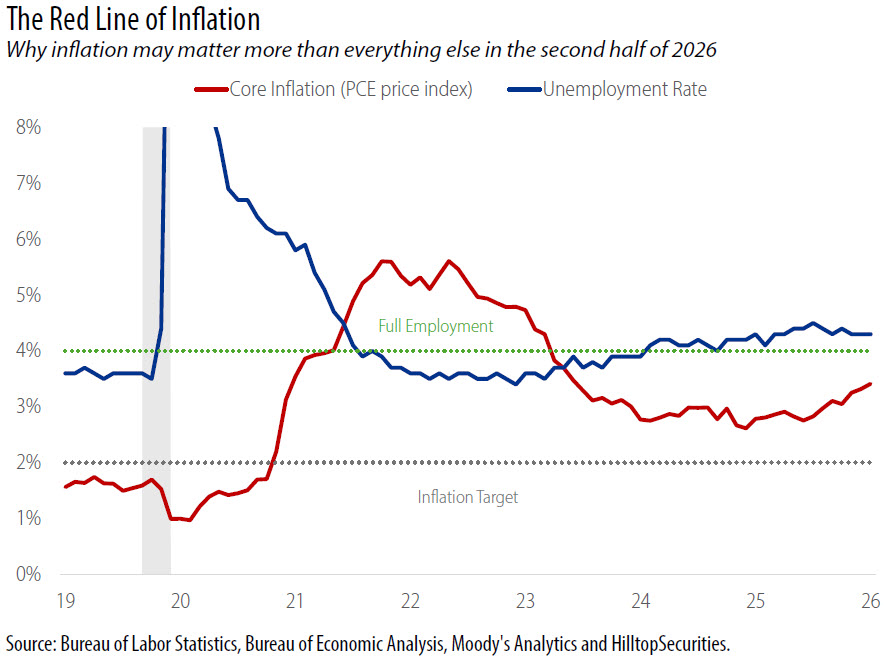
That is why the second half of 2026 should be viewed less as a single, or ongoing Fed story and more as a constrained economy story. Inflation is the starting point, but the real issue is how inflation interacts with borrowing costs, fiscal pressure, infrastructure needs, energy demand and competition for capital. Those interactions will shape public finance conditions and separate issuers with flexibility from those with less room to maneuver.
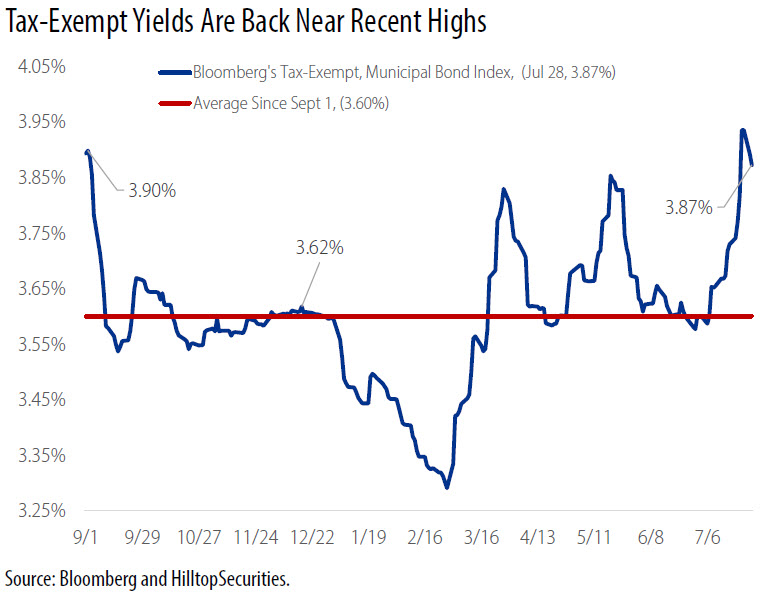
Demand for municipal bonds has been the defining, and surprising, municipal market story of 2026 so far. Investors have continued to choose tax-exempt income, relative stability and the bonds that finance America’s public infrastructure with important consistency. This recurring demand did not depend on one Fed action or one month of favorable market-specific technicals. It grew because investors recognized the value of tax-exempt income, understood the relative credit stability and connected the investment to roads, schools, airports, water systems, public power and other essential public assets at a time of macroeconomic and geopolitical uncertainty.
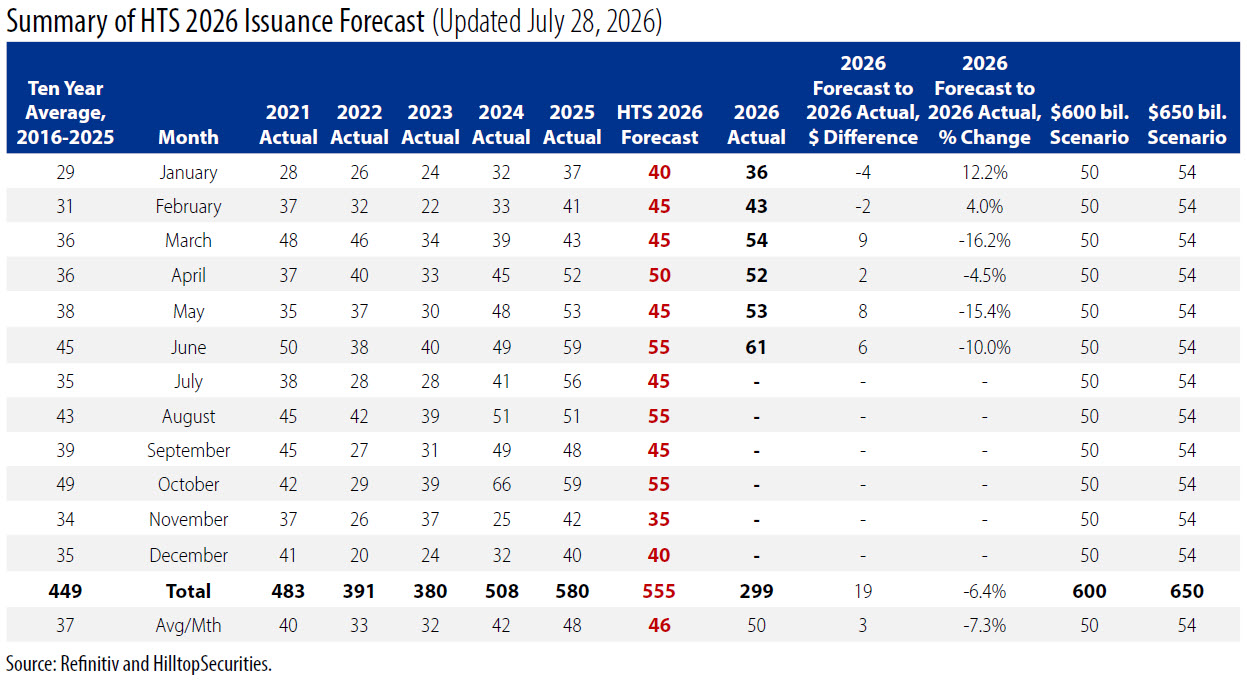
The sustained demand has been strong enough to absorb another historically heavy supply year, through the first half of the year. Municipal issuance totaled about $299 billion through the first six months of 2026, about $19 billion ahead of our $280 billion first-half forecast. Primary market issuance reached a record $580 billion in 2025, and 2026 is still running at an elevated pace that could come close to last year’s record. The elevated issuance activity is not surprising. Public capital needs remain large, construction costs remain high, federal pandemic-era support has faded, and infrastructure still must be financed. Prepay energy bonds are also making up a larger share of overall issuance and remain part of the supply story.
The heavy-issuance story is likely to continue in the second half of 2026. Our $555 billion full-year forecast was already at the low end of most 2026 municipal issuance forecasts. If issuance averages about $50 billion per month through October and then slows in November and December, full-year issuance could finish near the mid-$570 billion range. That would be above our forecast, but not enough by itself to change our base case. We would need to see a sustained trend that makes $600 billion more likely than a mid-$570 billion finish before revising our forecast higher.
Strong demand for municipals does not make the market immune to weakness. Heavy supply still has to be absorbed, relative value can shift, and strong flows can push investors too quickly into structures or credits that do not deserve the same confidence as the broader high-grade market. Absolute yields remain one of the strongest reasons to stay engaged with municipals, especially as investors move beyond cash and look to lock in tax-exempt income. But attractive yields, even generationally attractive yields, should not become an excuse to ignore underlying credit fundamentals.
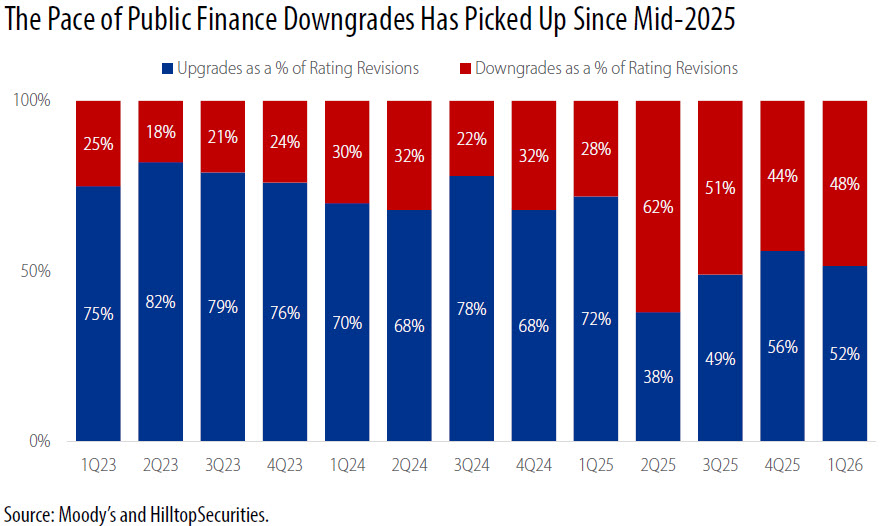
That is where the importance of the Post-Golden Age Realignment comes into play. For several years the sugar rush from D.C. propped up municipal credit. Municipal credit remains broadly stable, but it is becoming less uniform. The peak of the pandemic-era fiscal glow is behind us. Federal support has faded, rating momentum has normalized, and in some sectors like K-12 schools and higher education has turned negative. Issuer-specific fundamentals matter more now. States generally remain well positioned. Many local governments too are relatively well positioned but the individual story is more important than last year and the year before. Essential-service infrastructure remains durable. But pockets of stress are becoming easier to identify, especially where revenues are politically exposed, costs are rising, capital needs are large or management flexibility is limited. We have not made changes to our sector credit outlooks since Feb. 2026.
The second half of 2026 should reward credit profiles with the discipline we expected to see to begin the year. Investors should watch credit selection (especially as credit turns lower), structure, liquidity, reserves, revenue control, labor costs, capital plans and management’s ability to act before pressure becomes visible in the ratings, or on balance sheets. Public entity credit fundamentals are not inherently weak as we enter the second half of 2026, but the backdrop is becoming less forgiving.
In the first half of 2026 the key story was demand for municipals. The test in the second half of 2026 will likely involve the importance of credit selection, and we will watch the supply and demand dynamic closely as it is likely to remain part of the story in some way in the second half as well.
Readers may view all of the HilltopSecurities Municipal Commentary here.
 As Head of Public Policy and Municipal Strategy, Tom Kozlik advises HilltopSecurities’ businesses and clients on strategies related to U.S. public policy, public finance, and infrastructure. He publishes regular commentary that provides insight into current trends affecting these themes across a variety of sectors and geographic regions. Kozlik is frequently featured in print, digital, and broadcast news segments and regularly offers his expertise as a keynote speaker and panelist at industry conferences and events across the country. He can be reached at 214.859.9439 or tom.kozlik@hilltopsecurities.com.
The paper/commentary was prepared by HilltopSecurities (HTS). It is intended for informational purposes only and does not constitute legal or investment advice, nor is it an offer or a solicitation of an offer to buy or sell any investment or other specific product. Information provided in this paper was obtained from sources that are believed to be reliable; however, it is not guaranteed to be correct, complete, or current, and is not intended to imply or establish standards of care applicable to any attorney or advisor in any particular circumstances. The statements within constitute the views of HTS Public Finance as of the date of the document and may differ from the views of other divisions/departments of Hilltop Securities Inc. In addition, the views are subject to change without notice. This paper represents historical information only and is not an indication of future performance. This material has not been prepared in accordance with the guidelines or requirements to promote investment research, it is not a research report and is not intended as such. Sources available upon request.
Hilltop Securities Inc. is a registered broker-dealer, registered investment adviser and municipal advisor firm that does not provide tax or legal advice. HTS is a wholly owned subsidiary of Hilltop Holdings, Inc. (NYSE: HTH) located at 717 N. Harwood St., Suite 3400, Dallas, Texas 75201, (214) 859-1800, 833-4HILLTOP.