

click below to login to your secure account
By
Tom Kozlik
Head of Public Policy and Municipal Strategy
Hilltop Securities Inc.
The municipal bond tax-exemption lowers the cost of financing public infrastructure. Because investors generally do not pay federal income tax on interest from qualifying municipal bonds, they generally accept lower yields than taxable financing would require. Those lower yields reduce borrowing costs for states, local governments, and other public entities, leaving more public resources available for infrastructure and essential services. Public borrowers remain responsible for selecting projects, identifying repayment sources, and repaying the debt.
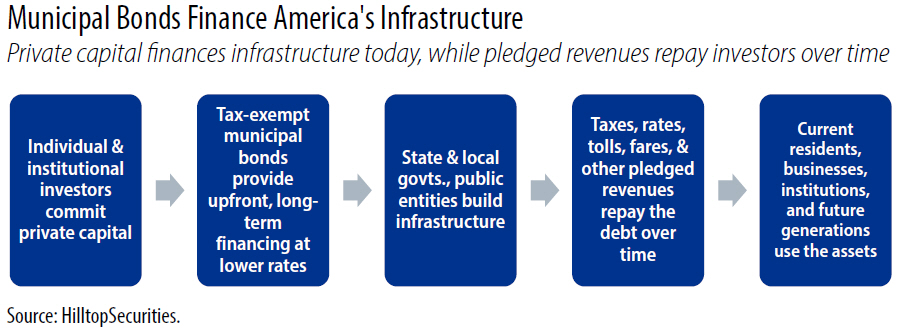
Federal support is justified because schools, transportation networks, water and sewer systems, hospitals, and other public assets serve people beyond the communities that finance them. Their benefits extend to future residents, commuters, businesses, visitors, neighboring jurisdictions, and the regional economy. Long-term municipal borrowing spreads repayment across the years these assets provide services, allowing more of the people who benefit from them to share their cost.
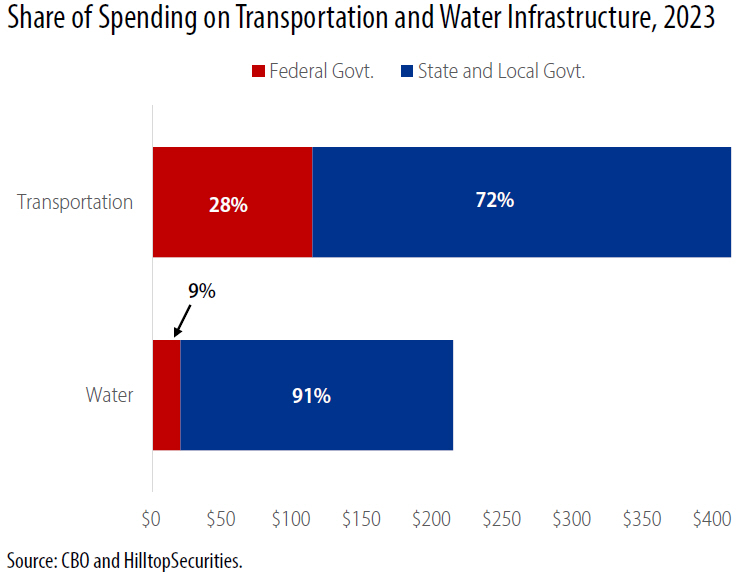
America’s infrastructure is built through a partnership among federal, state, local, public, and private participants, but much of the financial responsibility rests at the state and local levels. Transportation and water infrastructure illustrate how that responsibility is often divided.
In 2023, state and local governments funded 72% of transportation infrastructure spending and 91% of water infrastructure spending, according to data from the Congressional Budget Office. State and local governments also own or operate many of the roads, bridges, transit systems, water utilities, schools, hospitals, and other facilities used in their communities. Federal assistance can accelerate investment and direct resources toward national priorities, but state and local governments and public entities remain responsible for much of the planning, repayment, operation, and maintenance of public infrastructure across the U.S. Private companies also own or operate infrastructure, including investor-owned water utilities and certain toll roads. These arrangements are concentrated in particular markets and locations and do not alter the central role of state and local governments in financing and providing public infrastructure.
Infrastructure funding and infrastructure financing are related, but they are not the same. Taxes, and fees such as utility charges, tolls, fares, and other revenues ultimately secure and pay for public assets. Municipal bonds often provide the financing mechanism that allows communities to build those assets before decades of future revenue have been collected. Individual and institutional investors supply the upfront capital, and borrowers repay the debt over time.
The municipal bond market converts future public revenues into infrastructure communities can use today. It also spreads repayment across an asset’s useful life, so that more of the people who benefit from the infrastructure investment can help pay for it. The municipal bond tax-exemption helps keep that financing affordable for public borrowers, taxpayers, and ratepayers.
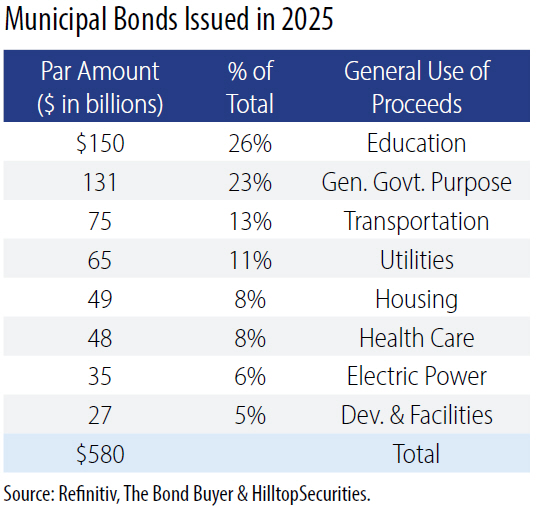
Municipal bonds financed public assets across American life in 2025, including schools, transportation systems, utilities, housing, health care, and other government and nonprofit facilities. Municipal bond issuance reached a record of approximately $580 billion last year, reflecting the scale of capital needs and refinancing activity among state and local governments and other public entities. Issuance increased approximately 13% from the previous record of $514 billion set in 2024. We are expecting close to, or another record year of issuance in 2026 as well.
The condition of America’s infrastructure has improved partially as a result of recent bond issuance, but substantial needs remain. After more than two decades in the “D” range, the 2025 Infrastructure Report Card from the American Society of Civil Engineers (ASCE) raised the national infrastructure grade from “C-minus” in 2021 to “C” in 2025, the highest grade since the report card began in 1998. Yet the ASCE still identified a $3.7 trillion gap between anticipated investment and the amount needed to bring the nation’s infrastructure into good working order over the next decade.
Recent federal, state, local, and private investment has helped produce measurable gains, but temporary federal programs cannot sustain that progress alone. ASCE identified municipal bonds as a major component of infrastructure finance in its 2025 report. The Infrastructure Investment and Jobs Act of 2021 also provided $550 billion in new federal spending that supported infrastructure investment in recent years.
The higher national ASCE grade shows that sustained investment can improve infrastructure. The remaining investment gap shows why communities will continue to need dependable and affordable access to the municipal bond market.
Investors receive the direct federal tax benefit, but state and local governments and other eligible borrowers receive the financing benefit because investors generally accept lower yields on tax-exempt bonds. Those lower yields reduce debt-service costs, allowing communities to devote more of their limited public resources to infrastructure and other public needs.
The public benefits of the tax-exemption extend well beyond only the investor. Residents, businesses, institutions, and public-service users rely on the assets financed through the municipal market. Long-term borrowing allows the generations using those assets to share their cost rather than placing the full burden on the taxpayers and ratepayers present when construction begins.
Federal support is also warranted when infrastructure serves people and businesses beyond the jurisdiction financing it. Commuters use roads and transit systems financed by communities where they do not live. Businesses depend on regional transportation, water, energy, and education systems. Visitors use airports, hospitals, public safety facilities, and other local infrastructure. Federal support recognizes that the jurisdiction financing an asset may bear most of the cost even when neighboring communities and the regional economy share in its value.
The exemption is particularly important for smaller communities and infrequent borrowers. Nearly two-thirds of the 8,219 tax-exempt issues sold in 2024 were less than $25 million, according to a joint 2025 policy report by the University of Texas at Austin’s LBJ School of Public Affairs and the University of Chicago’s Harris School of Public Policy. Without the municipal bond tax-exemption, these borrowers would have to compete for capital in a taxable market where investors often favor larger and more liquid transactions. Repeal could therefore increase financing costs and make it more difficult for some smaller public entities to attract investors on reasonable terms. The municipal bond tax-exemption should be judged not only by the federal revenue it forgoes, but by the infrastructure it finances, the local borrowing capacity it preserves, and the costs that repeal would shift to communities and households.
Eliminating the exemption would not eliminate the need to repair existing infrastructure or build new assets. It would change how much communities pay and who bears the cost. Removing a federal tax expenditure would not eliminate its cost. That cost would reappear in state and local budgets through higher debt service and reduced borrowing capacity, and in household budgets through higher taxes, rates, and fees.
State and local governments already bear much of the responsibility for public infrastructure. Repeal would raise the cost of repairing roads and bridges, modernizing schools and hospitals, and upgrading water and sewer systems. It would also reduce borrowing capacity and increase pressure on public budgets, taxpayers, and infrastructure users.
Those costs would reach households through higher taxes, fees, and charges for public services. Moderate and lower-income families could feel the consequences most acutely because utility bills, transit fares, tolls, sales taxes, and public-service charges consume a larger share of their income. These households also tend to have fewer private alternatives when public infrastructure and services are reduced.
Where communities could not raise additional revenue, the cost would appear through reduced services, deferred maintenance, and less infrastructure investment. As long as the underlying needs remain, repeal would function much like an unfunded mandate on state and local governments. The Government Finance Officers Association’s (GFOA) Public Finance Network estimates that repeal could increase state and local borrowing costs by approximately $824 billion over 10 years, an amount equivalent to about $6,500 per household. The estimate is a projection rather than a guaranteed outcome, but it illustrates the scale of the costs that could be shifted to state and local borrowers.
Critics correctly note that the exemption carries a federal revenue cost and that higher-income investors receive a share of its immediate tax benefit. Those concerns deserve consideration, but they do not capture the policy’s full purpose. The tax-exemption provides a relatively predictable, market-based source of private capital that lowers infrastructure financing costs while leaving state and local borrowers responsible for selecting projects, identifying repayment sources, disclosing financial information, and repaying the debt. This dependable access to the tax-exempt market allows public borrowers to plan multiyear capital programs in a way that future federal appropriations and competitive grants do not.
The modern threat to the tax-exemption emerged from the federal government’s search for structural balance after the Great Recession, when federal debt held by the public rose from 35% of gross domestic product in 2007 to 61% in 2010. In December 2010, the Bowles-Simpson Commission’s “The Moment of Truth” proposed eliminating all tax expenditures, including the municipal bond tax-exemption, as part of a broader plan to lower tax rates and reduce federal deficits. That approach placed the exclusion for municipal bond interest directly at risk.
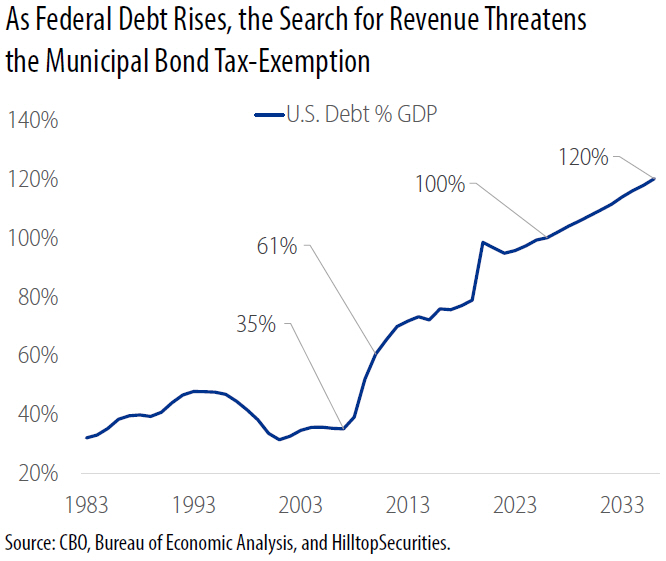
The threat became more severe in 2017, and public entities lost a portion of the tax-exemption then. The House version of the Tax Cuts and Jobs Act would have eliminated tax-exempt private activity bonds. The final law preserved them but ended the use of tax-exempt bonds for advance refundings. Congress made that policy choice to help offset the cost of the tax bill, not as part of a stand-alone effort to reduce federal deficits.
The exemption faced its most immediate threat since 2017 during consideration of the One Big Beautiful Bill Act of 2025, when full or partial repeal appeared among potential offsets. Congress ultimately preserved the exemption and expanded tax-exempt financing to include certain spaceport facilities. Rather than fully offset the legislation’s cost, lawmakers accepted a larger federal deficit. The Congressional Budget Office estimated that the law would increase the federal deficit by about $4 trillion.
Except for the 2017 loss of tax-exempt advance refundings, the exemption has emerged largely intact from repeated federal tax and policy debates. Congress has often protected it because lawmakers found other sources of revenue, accepted larger deficits, or pursued different priorities, not because they reached a lasting agreement about its value. Its survival should not be mistaken for lasting policy protection. Until lawmakers more fully understand what the exemption finances and who would bear the cost of repeal, it will remain vulnerable whenever Washington searches for additional revenue.
The case for preserving the municipal bond tax-exemption rests on what the financing tool makes possible and who would bear the cost if it disappeared. The GFOA’s Public Finance Network estimates that repeal could increase state and local borrowing costs by approximately $824 billion over ten years, an amount equivalent to about $6,500 per household.
Congress should preserve the exemption for governmental bonds and qualified private activity bonds and avoid restrictions that would place smaller and infrequent borrowers at a disadvantage. Any proposed change should be evaluated by its effects on infrastructure investment, state and local budgets, market access, and household costs.
Weakening or repealing the exemption would not eliminate the need for infrastructure or the obligation to pay for it. It would make public investment more expensive and shift more of the cost to communities and households. That case must be made before the next federal revenue debate begins. Continued education and advocacy are necessary so lawmakers understand not only what the exemption costs the federal government, but also what it finances, who relies on it, and who would pay more if it were weakened or repealed.
 As Head of Public Policy and Municipal Strategy, Tom Kozlik advises HilltopSecurities’ businesses and clients on strategies related to U.S. public policy, public finance, and infrastructure. He publishes regular commentary that provides insight into current trends affecting these themes across a variety of sectors and geographic regions. Kozlik is frequently featured in print, digital, and broadcast news segments and regularly offers his expertise as a keynote speaker and panelist at industry conferences and events across the country. He can be reached at 214.859.9439 or tom.kozlik@hilltopsecurities.com.
The paper/commentary was prepared by HilltopSecurities (HTS). It is intended for informational purposes only and does not constitute legal or investment advice, nor is it an offer or a solicitation of an offer to buy or sell any investment or other specific product. Information provided in this paper was obtained from sources that are believed to be reliable; however, it is not guaranteed to be correct, complete, or current, and is not intended to imply or establish standards of care applicable to any attorney or advisor in any particular circumstances. The statements within constitute the views of HTS Public Finance as of the date of the document and may differ from the views of other divisions/departments of Hilltop Securities Inc. In addition, the views are subject to change without notice. This paper represents historical information only and is not an indication of future performance. This material has not been prepared in accordance with the guidelines or requirements to promote investment research, it is not a research report and is not intended as such. Sources available upon request.
Hilltop Securities Inc. is a registered broker-dealer, registered investment adviser and municipal advisor firm that does not provide tax or legal advice. HTS is a wholly owned subsidiary of Hilltop Holdings, Inc. (NYSE: HTH) located at 717 N. Harwood St., Suite 3400, Dallas, Texas 75201, (214) 859-1800, 833-4HILLTOP.