

click below to login to your secure account
By
Tom Kozlik
Head of Public Policy and Municipal Strategy
Hilltop Securities Inc.
We anticipated that 2026 would be a discipline year, one in which credit outcomes would increasingly depend on planning, strategy, and budget decisions rather than inherited momentum. Moody’s second-quarter public finance rating actions suggest that the Post-Golden-Age Realignment continues to unfold. Economic growth remains supportive. Most state and local governments remain financially stable. Yet downgrades are not only increasing but outpacing upgrades overall and in certain sectors. This dynamic suggests that broad economic and fading fiscal support is no longer powerful enough to overwhelm structural weaknesses in certain sectors and among certain issuers.
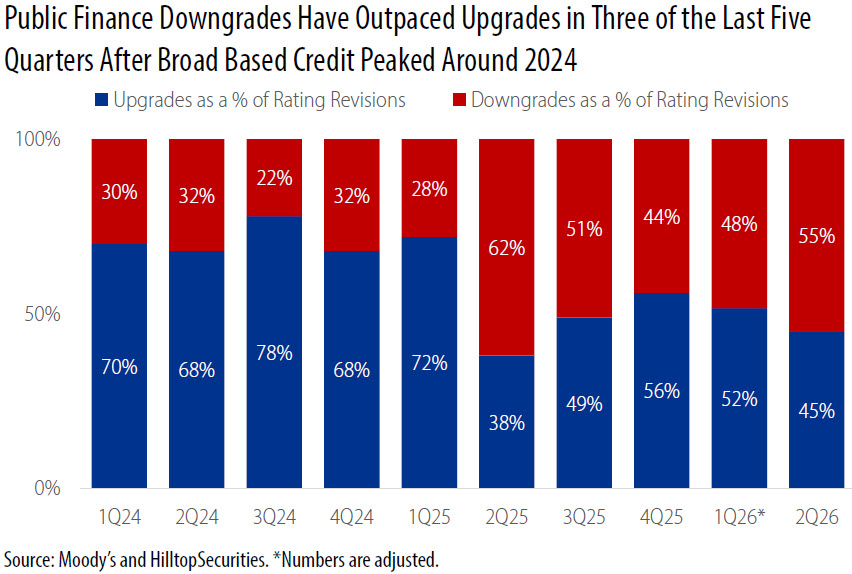
The quarterly headline is that downgrades exceeded upgrades by 116 (55%) to 96 (45%). Similar periods occurred during and/or just after the Great Financial Crisis and the COVID-19 crisis. The more important message today is that relatively stable fundamentals are no longer producing uniform credit outcomes. K-12 school districts accounted for more than half of all downgrades. Higher Education continued to record more downgrades than upgrades. The Healthcare sector recorded more downgrades than upgrades for the first time since the end of 2025.
These developments do not describe a municipal market where credit quality is moving uniformly lower. This is not a broad-based municipal credit deterioration story. Most state and local governments and public entities remain financially stable, and most credits continue to demonstrate resilience. Economic growth and fiscal support are simply no longer enough to overcome structural challenges in certain sectors.
During the Golden Age of Public Finance, federal support, strong revenue growth, reserve fund accumulation, and economic activity lifted much of the municipal market all at the same time. The Post-Golden Age Realignment began as those extraordinary tailwinds faded. Entering 2026, we argued that credit quality had reached a plateau and that further progress would increasingly depend on issuer-level “discipline.”
Moody’s second quarter data reinforces that view. Economic conditions still matter, but they no longer determine credit outcomes on their own. Factors such as demographics, enrollment trends, competition, labor costs, governance, and fiscal management are becoming more decisive, especially in certain sectors.
Evidence from the K-12 School District sector offers the clearest example so far. Moody’s reported that the sector has recorded more downgrades than upgrades for five consecutive quarters. School districts accounted for 68 of the 91 local government downgrades in the second quarter of 2026. Declining school-age populations and greater competition are adding pressure. K-12 credit quality is not deteriorating everywhere. Pressures and solutions differ from one district to another. Two districts operating in the same state and under similar economic conditions can follow very different credit paths.
Activity in the Higher Education sector reflects challenges as well. Moody’s recorded nine downgrades and one upgrade during the quarter, consistent with our “Negative” outlooks for both Public and Private higher education. Enrollment pressure, changing student preferences, rising costs, and competition continue to separate institutions with financial flexibility, and strong market positions from those with fewer options in the current environment.
And the Healthcare sector is showing signs of pressure supporting our “Cautious” sector outlook. Labor costs, reimbursement pressure, capital needs, and fiscal management are producing increasingly different results across healthcare systems.
This environment continues to raise the importance of credit selection for investors. Credit selection is the process of identifying issuers with the financial capacity, discipline, operating flexibility, and willingness to adapt as conditions change. The practice of credit selection when investing in municipal bonds requires investors to look beyond sector labels and broad economic forecasts to determine which issuers can recognize pressure early, make difficult adjustments, and preserve and maintain structural balance before circumstances force the issue.
Entities with strong credit profiles do not avoid challenges. They maintain reserves, preserve flexibility, understand their operating risks, and make adjustments while choices remain available. Entities with weaker credit profiles often wait until reserves decline and financial options narrow. This is the type of circumstance that can lead to rating downgrades.
Moody’s second quarter data confirms what we expected entering 2026. The municipal market is moving from broad credit momentum toward greater credit differentiation, where issuer-specific fundamentals can matter more than broad economic tailwinds. The defining question in U.S. public finance is no longer whether conditions are generally improving or deteriorating. It is which issuers and sectors can adapt to changing demographic, economic, policy, and competitive realities, and which cannot, or will not. That distinction is becoming increasingly visible in credit performance and rating actions.
Readers may view all of the HilltopSecurities Municipal Commentary here.
 As Head of Public Policy and Municipal Strategy, Tom Kozlik advises HilltopSecurities’ businesses and clients on strategies related to U.S. public policy, public finance, and infrastructure. He publishes regular commentary that provides insight into current trends affecting these themes across a variety of sectors and geographic regions. Kozlik is frequently featured in print, digital, and broadcast news segments and regularly offers his expertise as a keynote speaker and panelist at industry conferences and events across the country. He can be reached at 214.859.9439 or tom.kozlik@hilltopsecurities.com.
The paper/commentary was prepared by HilltopSecurities (HTS). It is intended for informational purposes only and does not constitute legal or investment advice, nor is it an offer or a solicitation of an offer to buy or sell any investment or other specific product. Information provided in this paper was obtained from sources that are believed to be reliable; however, it is not guaranteed to be correct, complete, or current, and is not intended to imply or establish standards of care applicable to any attorney or advisor in any particular circumstances. The statements within constitute the views of HTS Public Finance as of the date of the document and may differ from the views of other divisions/departments of Hilltop Securities Inc. In addition, the views are subject to change without notice. This paper represents historical information only and is not an indication of future performance. This material has not been prepared in accordance with the guidelines or requirements to promote investment research, it is not a research report and is not intended as such. Sources available upon request.
Hilltop Securities Inc. is a registered broker-dealer, registered investment adviser and municipal advisor firm that does not provide tax or legal advice. HTS is a wholly owned subsidiary of Hilltop Holdings, Inc. (NYSE: HTH) located at 717 N. Harwood St., Suite 3400, Dallas, Texas 75201, (214) 859-1800, 833-4HILLTOP.