

click below to login to your secure account
By
Tom Kozlik
Head of Public Policy and Municipal Strategy
Hilltop Securities Inc.
Municipal bond credit quality may have peaked, which is one reason credit selection matters more now. Public pensions are one of the more encouraging exceptions to the current realignment. Funded ratios have improved, contribution discipline has strengthened, and recent investment performance has helped repair some of the fiscal damage that built up after the Great Financial Crisis of 2008 and the long period of low interest rates that followed.
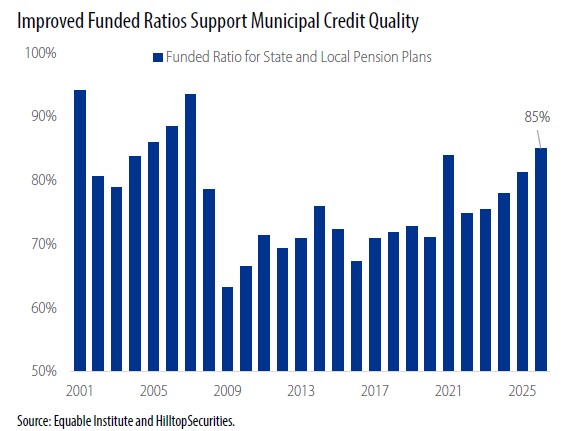
Better funding and stronger funded ratios do not mean pension risk has disappeared. Liabilities have come down, but they remain roughly double their pre-Great Financial Crisis of 2008 level. The risk is still there, not because it cannot be reduced, but because reducing it requires harder budget and funding choices. Avoiding those choices now can leave governments facing much larger pension contributions in harder fiscal circumstances.
Important and emerging public pension risks today are not limited to technology, artificial intelligence, or cryptocurrency-related investments. The larger issue is that many public pension systems remain heavily exposed to equities and other volatile investments at a time when stronger funding conditions offer an opportunity to reduce risk. Pension actuaries and plan managers often call this “de-risking.” It means using a stronger funding position to lower the chance that the next market downturn forces public budgets to make up a larger shortfall. Most public plans are not de-risking. This matters because public pension shortfalls are ultimately funded by taxpayers or by dollars redirected from other public priorities. Every dollar used to make up a deficit is a dollar that cannot be used for infrastructure, K-12 education, water or transportation systems, or other public needs.
This tradeoff can eventually limit state and local government budget flexibility, weaken credit quality, and affect underlying ratings. That is why public pension risk remains an important part of municipal bond credit analysis. When public pension assets decline or contribution requirements rise, the pressure moves through and impacts government budgets. The question for public finance and especially investors is not whether pension systems had a good year of investment returns. The question is whether this period of strength is being used to lower risk, or whether market gains are masking a still-fragile long-term position.
At the beginning of 2010, Pew published The Trillion Dollar Gap, Underfunded State Retirement Systems and the Road to Reform. For many readers, both inside and outside public finance, the report was one of the first broad quantitative looks at the scale of public pension risk. Pew estimated a $1 trillion gap at the end of fiscal 2008. The report focused only on states, but the warning was broader. Pension shortfalls were not simply the result of market losses. They also reflected policy choices, including skipped or reduced actuarially recommended payments (also known as pension funding holidays) and benefit expansions that did not fully account for long-term costs.
More than 15 years later, the picture has improved. The Equable Institute estimated, in their recent report State of Pensions 2026, that the national public pension funded ratio reached 85.0% in 2026, up from 81.2% in 2025. That is the best funded status since 2009 and the fourth consecutive year of improvement. Equable also estimated that total unfunded liabilities declined to $1.13 trillion in 2026, down $210 billion from 2025.
Moody’s Ratings reported a similar improvement. In its July 29, 2026, analysis, “Unfunded Pension Liabilities Fall for Sixth Consecutive Year as Asset Returns Soar.” Moody’s estimated that state and local government adjusted net pension liabilities declined for the sixth consecutive fiscal year, falling to about $1.8 trillion as of June 30, 2026. Moody’s estimated that adjusted net pension liabilities (ANPLs) have declined by about $4.25 trillion since peaking in 2020. Higher interest rates drove most of the multiyear decline, while strong fiscal 2026 investment returns played the largest role recently.
Recent investment gains were substantial. Equable estimated a 9.37% average public plan return for 2026, above the 6.9% average assumed return and the fourth consecutive year public plans beat their assumed return target. Moody’s estimated even stronger fiscal 2026 performance, with a composite public pension of about 16% for the fiscal year ended June 30, 2026, well above typical annual return targets in the 6.75% to 7.25% range.
This is the better part of the public pension message in mid-2026. Strong returns, higher interest rates, and better contribution discipline have improved several pension indicators. Much of the public pension picture is on better footing than it was before the COVID crisis. Stronger pension funding can reduce long-term budget pressure, support balance sheets and credit quality, improve fixed-cost trends, and give issuers more budget flexibility.
National averages hide the uneven condition of public pensions. Equable reported that roughly 31% of plans are in “Resilient” funded status, its category for plans that generally have a funded ratio of 90% or more. Equable defines “Fragile” plans as those consistently funded between 60% and 90%, and “Distressed” plans as those funded below 60%. Close to 70% of plans are designated as either “Fragile” or “Distressed.” The funding numbers are better overall, but this is not a broadly healthy system. It is a better-funded system that remains meaningfully exposed to the next equity market downturn.
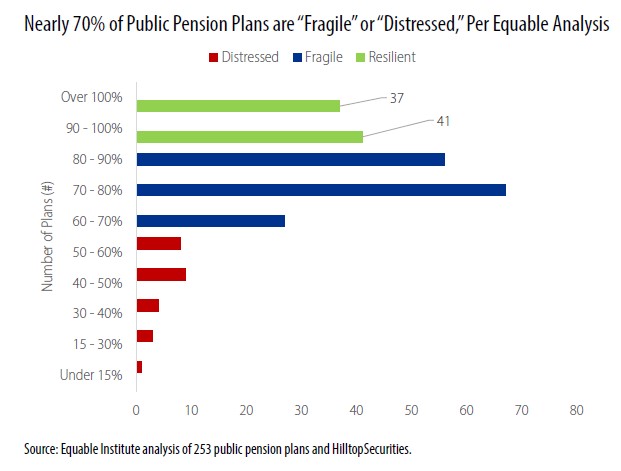
This distinction matters. A plan that is 85% funded is in a very different place than one that is 55% funded. A state or local government that can keep making full actuarially determined contributions (ADC) is in a very different place than one relying on optimistic assumptions, contribution reductions, or one-time budget maneuvers. Public pension risk remains concentrated in weaker plans and in state and local governments with less budget flexibility.
Even after years of strong market returns and better funding discipline, governments are still paying for yesterday’s pension shortfalls at a level that competes with today’s public priorities. Pension costs can stop getting worse and remain a meaningful budget pressure.
AI-related holdings have become an important public pension topic, but they should not define the entire risk conversation. Equable estimated that roughly 10% of public pension assets are directly exposed to AI-related companies. That matters because AI is no longer just a technology-sector story. It is embedded in public equity performance, private-market valuations, pension portfolios, government revenue expectations, and possibly future workforce assumptions. But the more important issue is not that public plans own AI-related equities. The more important issue, from a budget and risk perspective, is that public pension systems remain much more exposed to equities and growth assets than private corporate defined benefit plans.
The public and private pension data point in very different directions. Moody’s fiscal 2026 public pension composite was 60% public equities and 20% fixed income. By comparison, Milliman reported that the 100 largest U.S. corporate defined benefit (DB) plans held 24% in equities, 53% in fixed income, and 23% in other investments at the end of fiscal 2025. It is close to a mirror image. Milliman also reported that since 2005, corporate pension equity allocations declined from about 62% to 24%, while fixed income allocations rose from about 29% to 53%.
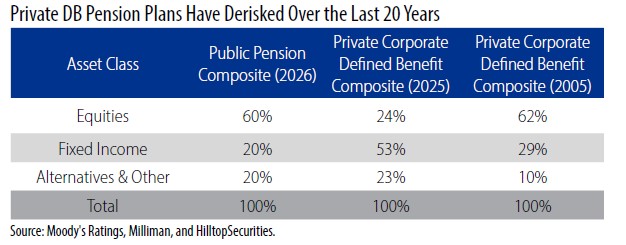
Private corporate defined benefit plans have moved much further toward fixed income. Public plans remain much more dependent on equity returns to support funded-ratio progress. That higher equity exposure helped public plans during strong market years, but it also leaves some public entities more exposed if or when markets weaken.
Stronger funding conditions should create an opportunity to reduce risk. A pension system that has benefited from several years of strong equity returns can shift more assets toward fixed income, reduce exposure to volatile investments, and lower the chance that the next market downturn forces higher employer contributions.
Moody’s wrote in its July 2026 report that very few U.S. public systems have acted to materially de-risk their asset allocations. Moody’s also outlined the incentive problem. State and local governments are arguably incentivized against pension asset de-risking because shifting from equities to fixed income lowers expected returns, which can make funding positions look worse on paper, raise contribution requirements, and reduce room to enhance benefits.
That is the issue municipal investors should really be focusing on today. A decision that reduces actual investment risk can make the reported pension picture look worse in the near term. A decision that keeps risk high can make near-term contribution requirements look easier. That does not make the risk disappear. It transfers more of the risk to future budgets and taxpayers.
The public pension story today is better, but it is still conditional. Funded ratios have improved. Returns have been strong. Contributions are more disciplined than they were in the years after the Great Financial Crisis of 2008. Several measures of pension health now look better than they have in years.
But the risk has not been eliminated. It has moved toward investment exposure, equity concentration, valuation risk, and the decision to either protect or spend the gains. If public plans remain heavily exposed to equities, if “Fragile” and “Distressed” plans remain vulnerable, and if better funding is used to reduce contributions or raise benefits instead of lowering risk, then municipal credit remains more exposed to the next market cycle. The current news is welcome, even positive. The discipline test is still ahead.
Readers may view all of the HilltopSecurities Municipal Commentary here.
 As Head of Public Policy and Municipal Strategy, Tom Kozlik advises HilltopSecurities’ businesses and clients on strategies related to U.S. public policy, public finance, and infrastructure. He publishes regular commentary that provides insight into current trends affecting these themes across a variety of sectors and geographic regions. Kozlik is frequently featured in print, digital, and broadcast news segments and regularly offers his expertise as a keynote speaker and panelist at industry conferences and events across the country. He can be reached at 214.859.9439 or tom.kozlik@hilltopsecurities.com.
The paper/commentary was prepared by HilltopSecurities (HTS). It is intended for informational purposes only and does not constitute legal or investment advice, nor is it an offer or a solicitation of an offer to buy or sell any investment or other specific product. Information provided in this paper was obtained from sources that are believed to be reliable; however, it is not guaranteed to be correct, complete, or current, and is not intended to imply or establish standards of care applicable to any attorney or advisor in any particular circumstances. The statements within constitute the views of HTS Public Finance as of the date of the document and may differ from the views of other divisions/departments of Hilltop Securities Inc. In addition, the views are subject to change without notice. This paper represents historical information only and is not an indication of future performance. This material has not been prepared in accordance with the guidelines or requirements to promote investment research, it is not a research report and is not intended as such. Sources available upon request.
Hilltop Securities Inc. is a registered broker-dealer, registered investment adviser and municipal advisor firm that does not provide tax or legal advice. HTS is a wholly owned subsidiary of Hilltop Holdings, Inc. (NYSE: HTH) located at 717 N. Harwood St., Suite 3400, Dallas, Texas 75201, (214) 859-1800, 833-4HILLTOP.