

click below to login to your secure account
By
Tom Kozlik
Head of Public Policy and Municipal Strategy
Hilltop Securities Inc.
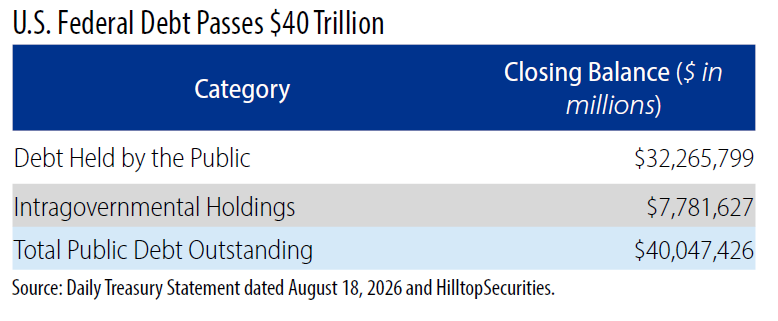
In May, we highlighted three numbers that could shape the U.S. fiscal situation, market outlook and U.S. infrastructure. They were the U.S. debt-to-GDP ratio, public confidence, and the 30-year Treasury yield. We can now add a fourth. The U.S. gross national debt has reached $40 trillion.
The debt crossed that threshold for the first time on Tuesday, according to the Daily Treasury Statement. It reached $39 trillion only five months earlier, in March. Total public debt outstanding stands at $40.047 trillion, including $32.266 trillion held by the public and $7.782 trillion held within the federal government.
Crossing $40 trillion does not create an immediate fiscal or market crisis. However, a key concern is that rising debt and interest costs will claim more federal resources, leaving policymakers with less room to support infrastructure, assist state and local governments, or respond to the next downturn or national emergency. Pressure could reach beyond Washington through tighter public budgets, higher borrowing costs, and increased scrutiny of federal policies because of deficit reduction efforts like the 2010 Bowles-Simpson Commission.
The American Society of Civil Engineers gave U.S. infrastructure a C grade in its 2025 Infrastructure Report Card, the highest since the report began in 1998. Sustaining that progress will require continued investment from every level of government.
Roads, bridges, transit systems, water and sewer facilities, K-12 schools, hospitals, higher education, and other public assets require continued investment and maintenance. State and local governments rely on the municipal bond market to finance much of this infrastructure. Higher rates increase debt-service costs, potentially forcing public entities to delay projects, reduce their scope, or defer maintenance. Those decisions may ease budget pressure today but lead to deterioration, higher repair costs, and the loss of recent infrastructure gains.
Federal budget pressure could further alter the changing relationship between Washington and state and local governments. If federal policymakers seek to restrain spending, they may reduce aid or shift costs to state and local governments and downstream public sector organizations.
Public entities could then face difficult choices. They may need to raise revenue, cut services, delay capital investment, or even borrow more. Governments with strong reserves, manageable fixed costs, and greater budget flexibility would be better prepared than those already under financial strain.
Investors will need to look more closely at which issuers can absorb higher interest costs, reduced federal support, or new spending responsibilities. Credit selection, already important in today’s credit environment, could likely matter even more.
The strongest municipal credits could attract additional safe-haven interest, particularly now that the United States is no longer rated Aaa/AAA by every major rating agency. Municipal securities carry their own credit, liquidity, tax, and market risks. Financially strong state and local governments, however, may receive more attention from investors seeking high-quality alternatives.
The federal debt burden could also intensify the threat to the municipal bond tax-exemption. As federal officials search for revenue or budget savings, the tax-exemption could again become a target, as it was in 2017. Reducing or eliminating it would make infrastructure financing more expensive for state and local governments and other public entities. The Government Finance Officers Association calculated that its elimination would cost $6,554 per American household over a decade. The municipal bond tax-exemption does not face an imminent threat, but rising federal debt increases the risk that policymakers could target it in future budget negotiations.
The $40 trillion milestone makes the fiscal constraint harder to ignore. As debt service claims more federal resources, the consequences could spread through infrastructure investment, public budgets, federal aid, and the municipal market. The risk is a steady erosion of the government’s capacity to invest for the future and respond when the next major challenge arrives. The impact to U.S. infrastructure and public finance might not be immediate, but it could be costly in different ways.
 As Head of Public Policy and Municipal Strategy, Tom Kozlik advises HilltopSecurities’ businesses and clients on strategies related to U.S. public policy, public finance, and infrastructure. He publishes regular commentary that provides insight into current trends affecting these themes across a variety of sectors and geographic regions. Kozlik is frequently featured in print, digital, and broadcast news segments and regularly offers his expertise as a keynote speaker and panelist at industry conferences and events across the country. He can be reached at 214.859.9439 or tom.kozlik@hilltopsecurities.com.
The paper/commentary was prepared by HilltopSecurities (HTS). It is intended for informational purposes only and does not constitute legal or investment advice, nor is it an offer or a solicitation of an offer to buy or sell any investment or other specific product. Information provided in this paper was obtained from sources that are believed to be reliable; however, it is not guaranteed to be correct, complete, or current, and is not intended to imply or establish standards of care applicable to any attorney or advisor in any particular circumstances. The statements within constitute the views of HTS Public Finance as of the date of the document and may differ from the views of other divisions/departments of Hilltop Securities Inc. In addition, the views are subject to change without notice. This paper represents historical information only and is not an indication of future performance. This material has not been prepared in accordance with the guidelines or requirements to promote investment research, it is not a research report and is not intended as such. Sources available upon request.
Hilltop Securities Inc. is a registered broker-dealer, registered investment adviser and municipal advisor firm that does not provide tax or legal advice. HTS is a wholly owned subsidiary of Hilltop Holdings, Inc. (NYSE: HTH) located at 717 N. Harwood St., Suite 3400, Dallas, Texas 75201, (214) 859-1800, 833-4HILLTOP.