

click below to login to your secure account
By
Tom Kozlik
Head of Public Policy and Municipal Strategy
Hilltop Securities Inc.
The Federal Open Market Committee left its target interest rate unchanged today, as expected. Attention now turns to the statement, any dissenting votes, and what Chair Kevin Warsh says, or does not say, about December. Chair Warsh has limited the forward guidance markets once relied upon, leaving investors to draw more of their own conclusions from the economic data and the Fed’s actions. A quarter-point increase at the Dec. 9 meeting remains possible if growth stays firm and inflation fails to ease. As of early Wednesday afternoon, federal funds futures placed the probability of a December increase near 86%.
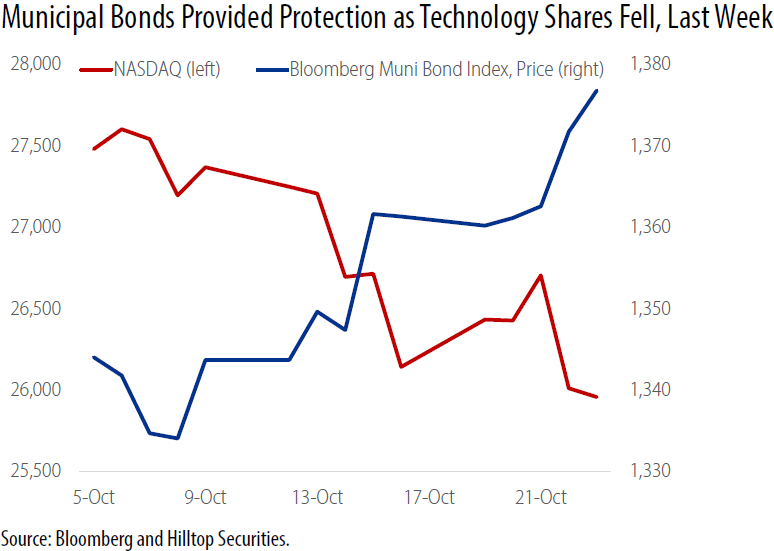
Last week provided an important reminder that bonds can still protect portfolios when risk assets weaken. Treasury and municipal yields fell as investors moved toward safety during a technology-led equity selloff. The traditional flight-to-safety relationship has been less reliable in recent months because economic strength, inflation pressure, heavy Treasury issuance, and changing expectations for Federal Reserve policy have sometimes pushed stocks and bonds lower at the same time. Last week, the more familiar relationship returned. Equity investors became more cautious, and bond prices rose in response.
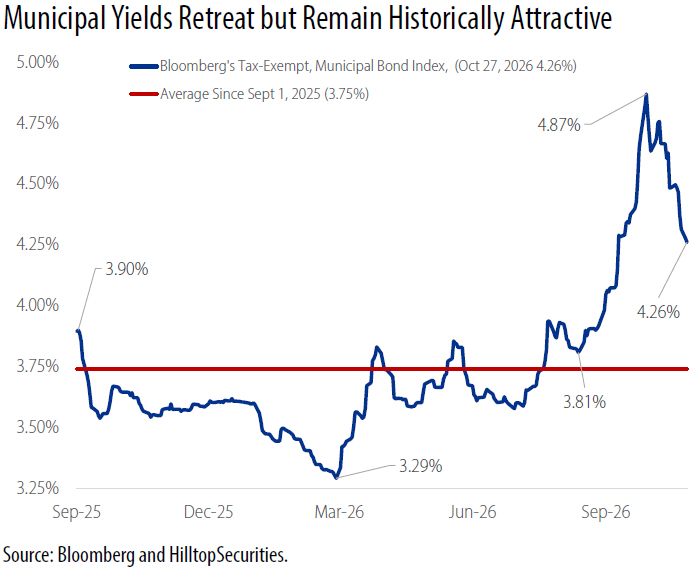
Municipal demand has remained strong. Municipal bond mutual funds recorded a third consecutive week of inflows exceeding $1.1 billion, including $1.6 billion last week. The yield on the Bloomberg Municipal Bond Index declined by over 60 basis points since reaching 4.87% in late September but still remains attractive at 4.26%. The 10-year AAA Municipal Market Data yield closed Tuesday at 3.46%, while the 30-year yield finished at 4.85%. Investors may have missed the market’s recent highest yields, but tax-exempt income remains attractive as demand strengthens and municipals regain some of their defensive value.
Municipal credit conditions remain uneven but relatively stable given the economic, political, and geopolitical uncertainty. We have made no broad changes to the HilltopSecurities sector outlooks published in February, although credit selection remains a priority. Investors should continue to examine the revenue structure, cost pressures, financial flexibility, and management decisions supporting individual issues.
The broader economy continues to provide support. The Federal Reserve Bank of Atlanta’s GDPNow model estimated annualized real GDP growth of 3.4% for the third quarter as of Oct. 27. The government’s initial reading is expected Thursday but, the estimate suggests that economic activity remained firm heading into the final quarter of the year.
Last week’s pressure on technology shares exposed a concern we have tracked throughout 2026. Investors recognize the potential of artificial intelligence, but they are paying closer attention to the cost of building it and the time required to earn an acceptable return. That concern became more visible around Meta, where questions about AI spending competed with confidence in the company’s underlying business.
The meaningful potential economic forces as it relates to accelerating technology remain considerable. Demis Hassabis, CEO of Google DeepMind, reportedly shortened his estimate for the arrival of artificial general intelligence (AGI) from a 50% chance within five years to two to three years, according to a Wall Street Journal article published last week. Separately, BofA Global Research estimated that global data-center spending could reach $1 trillion in 2026 and $2.1 trillion by 2028. These forecasts are not assurances, but together they point toward faster technological development and sustained demand for hardware, construction, electricity, cooling systems, and supporting infrastructure.
Mark Zandi, chief economist at Moody’s Analytics, estimates that AI-related activity already accounts for roughly one-third of U.S. economic growth. That represents approximately 0.6 to 0.7 percentage points of an economy growing near 2%. Without that support, Zandi estimates that the rest of the economy would be expanding by only 1% to 1.5%. The AI investment cycle may therefore be placing a meaningful floor beneath economic activity even as other parts of the economy soften.
This creates a more complicated interest-rate outlook than last week’s bond rally might suggest. A flight to safety can push yields lower when equity markets come under pressure. At the same time, sustained AI and data-center investment will compete for capital, labor, electricity, equipment, and construction capacity. If that spending keeps economic growth near or above 2%, inflation and interest rates may remain higher than investors became accustomed to during the low-rate period.
Geopolitical uncertainty and the approaching midterm elections provide additional sources of volatility. Affordability, federal deficits, and tax policy will remain important issues for municipal investors. None of these forces means that yields must move in one direction. Municipal bonds can benefit from defensive demand without entering an uninterrupted period of falling interest rates.
 As Head of Public Policy and Municipal Strategy, Tom Kozlik advises HilltopSecurities’ businesses and clients on strategies related to U.S. public policy, public finance, and infrastructure. He publishes regular commentary that provides insight into current trends affecting these themes across a variety of sectors and geographic regions. Kozlik is frequently featured in print, digital, and broadcast news segments and regularly offers his expertise as a keynote speaker and panelist at industry conferences and events across the country. He can be reached at 214.859.9439 or tom.kozlik@hilltopsecurities.com.
The paper/commentary was prepared by HilltopSecurities (HTS). It is intended for informational purposes only and does not constitute legal or investment advice, nor is it an offer or a solicitation of an offer to buy or sell any investment or other specific product. Information provided in this paper was obtained from sources that are believed to be reliable; however, it is not guaranteed to be correct, complete, or current, and is not intended to imply or establish standards of care applicable to any attorney or advisor in any particular circumstances. The statements within constitute the views of HTS Public Finance as of the date of the document and may differ from the views of other divisions/departments of Hilltop Securities Inc. In addition, the views are subject to change without notice. This paper represents historical information only and is not an indication of future performance. This material has not been prepared in accordance with the guidelines or requirements to promote investment research, it is not a research report and is not intended as such. Sources available upon request.
Hilltop Securities Inc. is a registered broker-dealer, registered investment adviser and municipal advisor firm that does not provide tax or legal advice. HTS is a wholly owned subsidiary of Hilltop Holdings, Inc. (NYSE: HTH) located at 717 N. Harwood St., Suite 3400, Dallas, Texas 75201, (214) 859-1800, 833-4HILLTOP.