

click below to login to your secure account
By
Tom Kozlik
Head of Public Policy and Municipal Strategy
Hilltop Securities Inc.
The decline in U.S. interest rates began during the inflation crisis of 1981, when the Federal Reserve under Paul Volcker fought entrenched inflation and the 10-year Treasury yield approached 16%. Nearly four decades later, during the first summer of the COVID crisis, the yield fell to roughly 0.5%. Likewise, the 10-year AAA MMD yield peaked at 11.50% in 1981 and bottomed out at 0.58% in the summer of 2020.
There is no universally accepted definition of a bull or bear market in bonds. Equities have a widely used benchmark. An equity bear market is generally defined as a decline of at least 20% from a recent high, while a bull market is commonly associated with a rise of at least 20%. Long-term bond cycles are more often identified through sustained movements in interest rates.
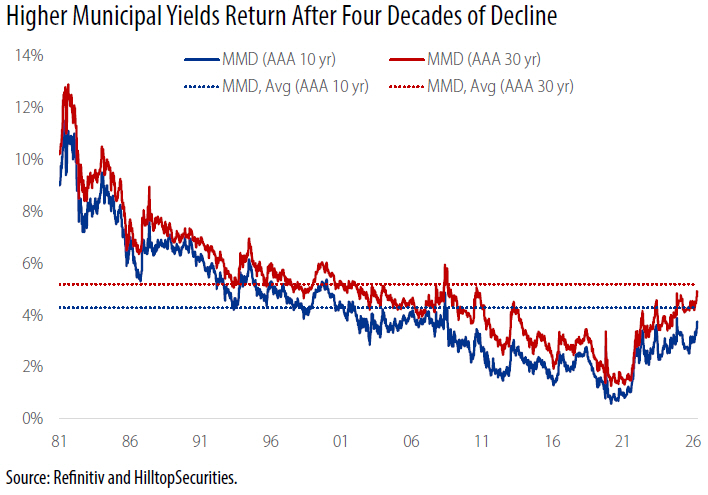
Investors and observers can debate whether a new bond bear market has begun. There should be less debate about the practical consequences of higher yields. The effects on investors, the broader economy, and the public sector will not be evenly distributed.
Stanley Druckenmiller captured the scale of the policy challenge facing federal officials and the public in his Wall Street Journal commentary, Let the Bond Market Speak. Druckenmiller criticized efforts to suppress long-term Treasury yields through expanded buybacks, arguing that federal officials risked interfering with signals from a functioning market.
The broader fiscal consequence is that federal debt maturing in a higher-rate environment will likely be refinanced at greater cost. Interest payments could then consume more of the federal budget, leaving less capacity for other priorities. Credible fiscal changes could ease investor concerns, but inflation, economic growth, monetary policy, Treasury supply, and other forces also affect yields. We examined how mounting federal debt could affect infrastructure and public finance in How $40 Trillion of Federal Debt Could Reach U.S. Infrastructure and Public Finance.
For fixed-income and municipal bond investors putting new money to work, higher yields can create opportunity, particularly in the tax-exempt municipal market. We wrote about that opportunity last week in The Bond Market Selloff Is Making Attractive M/T Ratios the New Municipal Opportunity of 2026. This opportunity remains. Municipal to Treasury ratios (M/T ratios) remain attractive, but credit selection has become more important, especially in the K-12 education, higher education, and health-care sectors.
Rising rates strengthen the case for even closer credit analysis. It has been decades since many public entities have had to finance capital projects in a persistently higher-rate environment. Some borrowers have the financial capacity, revenue flexibility, and management discipline to adjust. Others are less prepared, so this is an important potential pressure to watch going forward.
Higher rates are intended to change economic behavior. That was one reason the Federal Open Market Committee (FOMC) raised its target rate by 25 basis points last week. Inflation has remained above target, while financial conditions have been more accommodative than what monetary policymakers would prefer (see the line chart on page two).
Higher borrowing costs reach consumers and households through mortgages, auto loans, credit cards, and other forms of credit. Homeowners with existing fixed-rate mortgages generally retain their current payments, while first-time homebuyers and other new borrowers face prevailing rates. As debt payments consume more income, households have less money available for other purchases.
Businesses may postpone investment or hiring as financing becomes more expensive. Higher mortgage rates could further weaken housing demand, while higher financing costs can slow construction and limit new housing supply. Over time, weaker spending, investment, and employment growth could restrain state and local tax revenue and place pressure on municipal credit.
Higher yields therefore offer investors greater income while also testing economic activity and the fiscal capacity of public entities.
Higher rates increase the cost of financing schools, roads, water and sewer systems, and other public assets. For state and local governments and other public entities, higher borrowing costs can mean less infrastructure for the same amount of debt capacity.
Public entities facing higher borrowing costs could:
Each potential choice carries a cost. Reducing a project’s scope may leave a sponsor without the capacity or infrastructure it needs. Raising taxes, fees, or user charges may be difficult. Delaying the investment could preserve near-term budget flexibility, but it could also increase construction and deferred maintenance costs while residents and businesses wait longer for needed infrastructure.
 As Head of Public Policy and Municipal Strategy, Tom Kozlik advises HilltopSecurities’ businesses and clients on strategies related to U.S. public policy, public finance, and infrastructure. He publishes regular commentary that provides insight into current trends affecting these themes across a variety of sectors and geographic regions. Kozlik is frequently featured in print, digital, and broadcast news segments and regularly offers his expertise as a keynote speaker and panelist at industry conferences and events across the country. He can be reached at 214.859.9439 or tom.kozlik@hilltopsecurities.com.
The paper/commentary was prepared by HilltopSecurities (HTS). It is intended for informational purposes only and does not constitute legal or investment advice, nor is it an offer or a solicitation of an offer to buy or sell any investment or other specific product. Information provided in this paper was obtained from sources that are believed to be reliable; however, it is not guaranteed to be correct, complete, or current, and is not intended to imply or establish standards of care applicable to any attorney or advisor in any particular circumstances. The statements within constitute the views of HTS Public Finance as of the date of the document and may differ from the views of other divisions/departments of Hilltop Securities Inc. In addition, the views are subject to change without notice. This paper represents historical information only and is not an indication of future performance. This material has not been prepared in accordance with the guidelines or requirements to promote investment research, it is not a research report and is not intended as such. Sources available upon request.
Hilltop Securities Inc. is a registered broker-dealer, registered investment adviser and municipal advisor firm that does not provide tax or legal advice. HTS is a wholly owned subsidiary of Hilltop Holdings, Inc. (NYSE: HTH) located at 717 N. Harwood St., Suite 3400, Dallas, Texas 75201, (214) 859-1800, 833-4HILLTOP.