

click below to login to your secure account
By
Tom Kozlik
Head of Public Policy and Municipal Strategy
Hilltop Securities Inc.
At the beginning of 2026, many investors expected interest rates to move lower. Eight months later, that assumption is becoming increasingly difficult to defend. Sticky inflation, a less communicative Federal Reserve, extraordinary demand for artificial intelligence (AI) investment capital, and persistent federal deficits are contributing to a broad repricing of the cost of money. As Stanley Druckenmiller observed this week, the long-term Treasury yield may be “the most important price in the world.” That price has moved sharply higher, particularly since the spring of 2026.
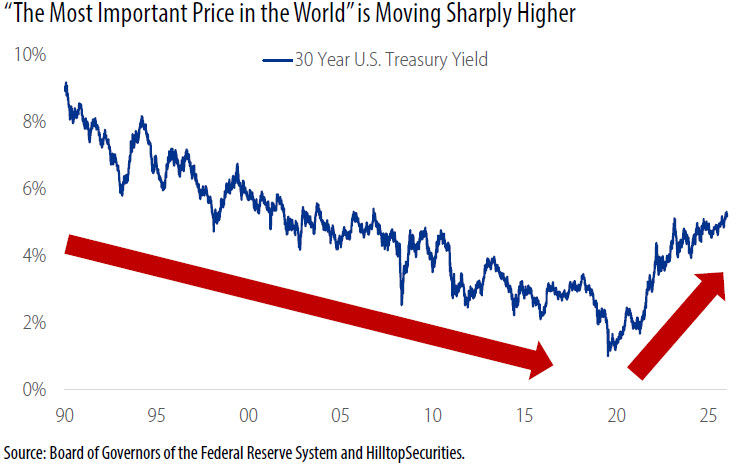
The result is more than higher yields. It is a growing recognition that the conditions supporting lower borrowing costs for much of the past decade can no longer be taken for granted. Interest rates may move lower at times, but the expectation that borrowing costs will steadily decline from current levels has become increasingly difficult to defend.
The first driver of elevated rates is inflation. We argued less than a month ago inflation was the leading theme for the second half of 2026 in Inflation and Everything Else. The conflict and negotiations involving the United States and Iran, along with disruptions affecting the Strait of Hormuz, have created renewed uncertainty around energy markets. Many investors initially expected these disruptions to prove temporary. Instead, they have become a drag on economic confidence and contributed to higher inflation expectations.
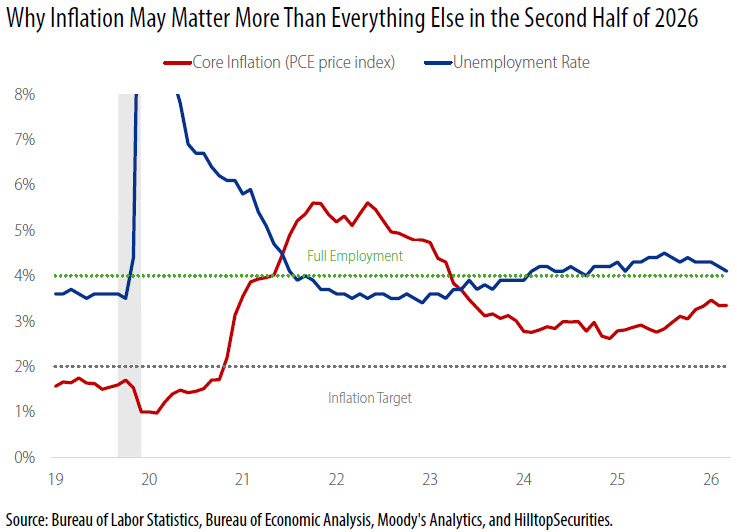
Inflation has also remained stubborn because the easier phase of the inflation fight is over. Goods prices have generally stabilized, but services such as housing, healthcare, insurance, and other labor-intensive areas of the economy continue to become more expensive. Those costs tend to move slowly and are often difficult to reverse.
At this point, this can be considered the Federal Reserve’s last-mile problem. Moving inflation from roughly 6% toward 3% proved difficult but achievable. Moving inflation from around 3% toward the Fed’s 2% target may prove even harder because the remaining inflation is concentrated in sectors where price pressures are more persistent.
The new Federal Reserve regime is also playing a role. At the first Federal Open Market Committee meeting under Chair Kevin Warsh, policymakers voted unanimously to keep the target range unchanged at 3.50% to 3.75%.
Even more notable than the decision itself was the communication surrounding it. The official statement was substantially shorter than previous versions and reflected Chair Warsh’s preference for limiting forward guidance. The emphasis shifted toward price stability and long-term economic fundamentals rather than detailed signaling about future policy moves.
This marked a meaningful departure from the Powell-era approach. Investors are now adjusting to a Federal Reserve that is providing fewer clues about the future path of rates. Less guidance does not necessarily mean worse policy. It does, however, mean greater uncertainty. When uncertainty rises, investors often demand additional compensation for risk, which can translate into higher borrowing costs across the economy.
Bond market intervention announced last week temporarily reduced yields, but the effect proved short-lived. Markets quickly returned their focus to inflation and long-term borrowing needs. Since then, in addition, the U.S Treasury secretary’s credibility has come under greater scrutiny.
One of the more underappreciated drivers of higher interest rates may be the extraordinary amount of capital required to build the infrastructure that will support more advanced artificial intelligence systems. This investment is helping fuel economic growth today and could ultimately improve productivity for years to come, despite the economic risks. PwC has described the effort as part of a potential multi-trillion-dollar investment super-cycle needed to modernize existing infrastructure and build the foundation of a new digital economy. To begin this buildout, the largest technology companies, often referred to as hyper-scalers, are investing heavily in data centers, computing infrastructure, semiconductor manufacturing, power generation, and transmission systems. The market issue is not a concern about the credit quality of these companies. Rather, the market issue is a potential crowding-out effect because of the growing amount of debt and capital needed to finance the initial investment.
Governments, corporations, households, and technology companies are all competing for financing capacity from the same interconnected global capital markets. As more borrowers seek funding, investors can demand higher yields before committing capital. The AI buildout has effectively become a new major competitor for investment dollars, diverting capital that might otherwise finance government deficits, corporate expansion, housing, or even projects financed by the U.S. municipal bond market. That competition for dollars is unlikely to fade because the infrastructure supporting artificial intelligence will require years of sustained investment.
Another part of the current financial backdrop has to do with the U.S. fiscal situation, which has largely worsened since President Trump signed his One Big, Beautiful Bill Act of 2025 tax legislation in July 2025. Since then, America has continued a pace of historically large government borrowing despite the absence of a recession. The International Monetary Fund expects the U.S. government to run a deficit equal to 7.5% of GDP in 2026, the largest among G7 nations. Meanwhile, federal public debt outstanding has already surpassed $40 trillion.
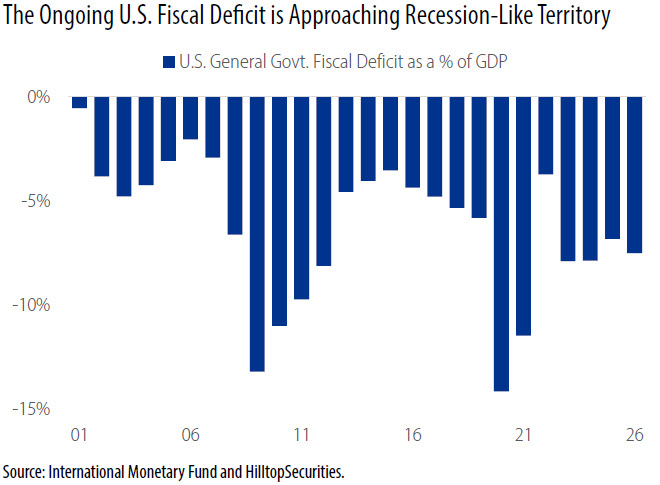
The U.S. fiscal outlook could become even more challenging if defense spending increases, interest costs continue rising, or policymakers continue postponing difficult federal budget decisions. Higher rates compound the problem because they increase the cost of servicing existing debt. Deficits matter also because deficits create future Treasury debt supply.
The U.S. fiscal story could also extend directly into the municipal market. Large deficits do not automatically threaten the municipal bond tax-exemption, but they increase the potential that policymakers could revisit long-standing tax expenditures whenever Washington begins looking for revenue or offsets.
Just this week, the Committee for a Responsible Federal Budget published Seven Ideas to Help the Administration Achieve Fiscal Consolidation. One part of the recommendation would limit certain tax expenditures. While that proposal is substantially less aggressive than the Bowles-Simpson Commission’s earlier recommendation to eliminate all tax expenditures including the municipal bond tax-exemption entirely, this proposal illustrates how quickly long-standing tax preferences can become part of deficit-reduction discussions.
This is not a direct, or imminent threat to the municipal bond tax-exemption today. It is, however, the type of proposal that could eventually pull the exemption back into policy discussions if pressure to reduce deficits intensifies.
This dynamic matters because the tax-exemption remains one of the most effective tools available for financing public infrastructure. The United States has made meaningful infrastructure progress in recent years, but substantial work remains. Water systems, transportation networks, energy infrastructure, schools, public facilities, and cybersecurity all require significant investment. The nation still carries a “C” infrastructure grade, as assigned by the American Society of Civil Engineers in 2025. Increasing financing costs would move the country further away from solving those challenges, not closer.
The Bloomberg Municipal Bond Index closed yesterday at 3.90%, near a high for 2026 and well above its average level over the past year. The takeaway for municipal investors is not simply that yields have moved higher. The more important point is that yields have risen while municipal credit fundamentals generally remain solid, although we have been stressing the importance of credit selection. Investors are being offered higher levels of income without a corresponding deterioration in credit across most municipal market sectors.
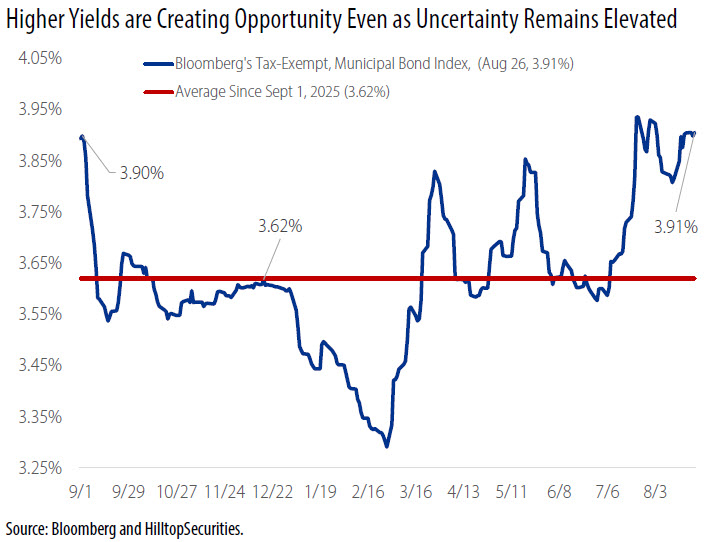
Current yields are comparable to some of the more attractive levels available during 2025. The difference today is that investors should not assume rates will steadily decline from here. Inflation uncertainty, reduced Fed guidance, AI-related demand for capital, and persistent federal borrowing needs may keep rates elevated for longer than many expected. That uncertainty should not necessarily discourage investors from putting capital to work. Higher yields mean investors are being paid more to take duration and credit risk than they were for much of the past several years.
For many investors, current tax-exempt yields appear increasingly attractive on both an absolute and after-tax basis. The municipal market remains very investible at these levels.
The story of 2026 may ultimately be the story of a broad repricing of money itself.
Sticky inflation has limited the Federal Reserve’s flexibility. A less communicative Fed has increased uncertainty. An unprecedented AI investment cycle has intensified competition for capital. Persistent federal deficits continue to expand government borrowing needs.
Any one of these forces alone could have pushed rates modestly higher. Together, they are forcing investors to reconsider a decade-long assumption that borrowing costs would naturally drift lower over time. Whether rates move significantly higher from here remains uncertain. What is becoming increasingly difficult to defend is the belief that lower rates are just around the corner.
For municipal investors, this environment creates both risk and opportunity. Higher borrowing costs may pressure issuers and increase scrutiny of the tax-exemption. At the same time, higher yields provide an opportunity for investors to secure income at levels that were difficult to find during much of the post financial-crisis era. The price of money is rising for now. The more important question is whether investors, issuers, and policymakers are prepared for what that higher price could actually cost.
 As Head of Public Policy and Municipal Strategy, Tom Kozlik advises HilltopSecurities’ businesses and clients on strategies related to U.S. public policy, public finance, and infrastructure. He publishes regular commentary that provides insight into current trends affecting these themes across a variety of sectors and geographic regions. Kozlik is frequently featured in print, digital, and broadcast news segments and regularly offers his expertise as a keynote speaker and panelist at industry conferences and events across the country. He can be reached at 214.859.9439 or tom.kozlik@hilltopsecurities.com.
The paper/commentary was prepared by HilltopSecurities (HTS). It is intended for informational purposes only and does not constitute legal or investment advice, nor is it an offer or a solicitation of an offer to buy or sell any investment or other specific product. Information provided in this paper was obtained from sources that are believed to be reliable; however, it is not guaranteed to be correct, complete, or current, and is not intended to imply or establish standards of care applicable to any attorney or advisor in any particular circumstances. The statements within constitute the views of HTS Public Finance as of the date of the document and may differ from the views of other divisions/departments of Hilltop Securities Inc. In addition, the views are subject to change without notice. This paper represents historical information only and is not an indication of future performance. This material has not been prepared in accordance with the guidelines or requirements to promote investment research, it is not a research report and is not intended as such. Sources available upon request.
Hilltop Securities Inc. is a registered broker-dealer, registered investment adviser and municipal advisor firm that does not provide tax or legal advice. HTS is a wholly owned subsidiary of Hilltop Holdings, Inc. (NYSE: HTH) located at 717 N. Harwood St., Suite 3400, Dallas, Texas 75201, (214) 859-1800, 833-4HILLTOP.