

click below to login to your secure account
By
Tom Kozlik
Head of Public Policy and Municipal Strategy
Hilltop Securities Inc.
The Federal Reserve Bank of Kansas City’s Jackson Hole Economic Policy Symposium focused on financial innovation, but the discussion went well beyond tokenization, payment systems, and the future of central banking. The larger question was whether artificial intelligence (AI), digital finance, and new requirements of capital formation are changing the structure of the economy and challenging modern monetary policy assumptions.
Fed Chair Kevin Warsh captured the weight of those questions in the title of his opening remarks, “In Our Time,” perhaps a reference to Ernest Hemingway’s 1924 short-story collection. Hemingway belonged to what Gertrude Stein called the “Lost Generation,” which came of age around World War I and itself confronted a world transformed by war, technology, radical politics, and social change. A century later, Warsh may be signaling that policymakers face another period of profound change. Technology is advancing quickly, capital is being allocated differently, and long-held economic assumptions and monetary policy processes are being tested.
The Fed Chair’s closing remarks captured both the weight of the moment and the historical parallel: “My Fed colleagues and I are hardly the first to hold these positions in a time of great consequence. We are determined to redeem the time by doing our very best work.” In that sense, Warsh’s “In Our Time” is more than a title. Warsh’s title recognizes that old assumptions may no longer hold and calls on policymakers to confront a changing economy with discipline. The FOMC’s three remaining meetings in 2026 could begin to show whether that philosophy becomes policy.
Markets have more data than ever, yet there seems to be less certainty today about what is likely to come next. For centuries, sailors crossed the world’s oceans by reading the stars, while scouts and explorers moving west across North America followed landmarks, rivers, animal tracks, weather patterns, and even broken vegetation. Technology has advanced, but the need for reliable signals in markets or traveling has not changed. With the Federal Reserve offering less forward guidance, investors are searching through every economic release and every word from Chair Warsh for clues about where interest rates may travel next. It is another signal hunt, but the backdrop has changed massively in the last 12 months.
Warsh began his Jackson Hole speech by describing two kinds of “hikes.” One was a punishing march with former Fed Vice Chair Don Kohn. The other was a leisurely walk with former Fed Chair Ben Bernanke. The story was lighthearted, but the question now facing markets and investors is not. What kind of policy hike is this new Fed prepared to take?
Warsh did not commit to a September decision. His speech was less about the next meeting than about changing the Fed’s operating philosophy. He wants a quieter central bank that gives markets less advance direction and retains more freedom to respond when conditions change.
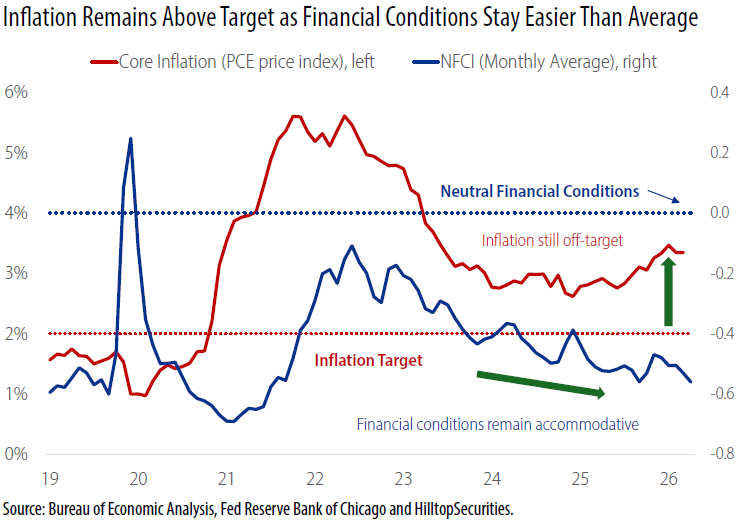
Warsh’s assessment of the economy did not make the case for easier policy. He described output as solid, labor markets as stable, and the economy as resilient. He also said that he would be “hard pressed to describe broad financial conditions as restrictive.” The accompanying chart shows the Chicago Fed’s National Financial Conditions Index (NFCI) at -0.57, indicating financial conditions are looser than average. He did not cite this data specifically, but the data supports his view.
Inflation presents the harder problem for the FOMC. Warsh said inflation remained above the Fed’s 2% target (see red dotted line in our line chart) and that recent readings did not show a meaningful improvement in the underlying trend. His conclusion was: “The Fed’s predominant focus right now should be on prices.”
The economic signals, or signs in our “signal hunt” therefore likely lean against additional relief. Inflation remains above target (see the green arrow point up). Financial conditions remain accommodative (see the green arrow pointing to the right and slightly down). Overall, the economy is strong, and the labor market remains resilient. The burden of proof is shifting toward those arguing for easier policy. The question is no longer simply why the Fed should keep rates elevated. It is what evidence would justify adding stimulus to an economy that does not appear to need it.
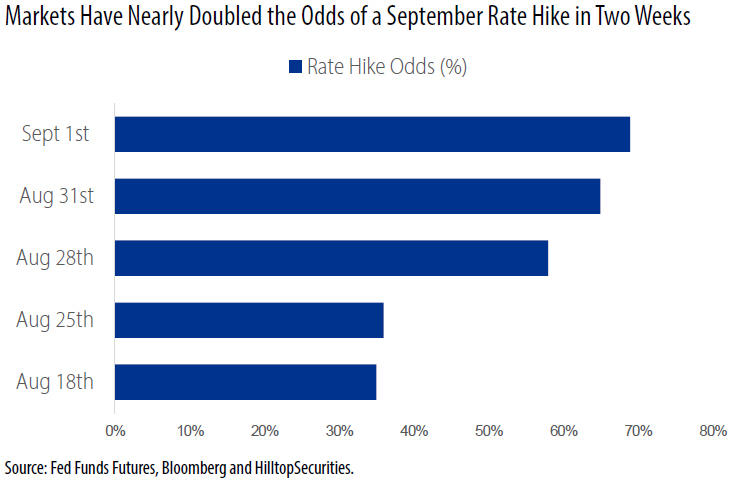
Markets have moved quickly toward the same conclusion. As of Sept. 1, Fed Funds futures placed the probability of a September rate hike at 69%, nearly double the 35% probability recorded August 18. The changing expectation shows that investors increasingly believe Warsh’s potential operating discipline could influence the next policy decision.
Warsh is still caught between an economic rock and a political hard place. The economic signals may support tighter policy. Political pressure favors lower rates, however. Mid-term elections are coming up fast, Nov. 3 to be exact. Warsh has promised a Fed that will base its decisions on the economy rather than political demands or even the market’s preferred outcome. The FOMC’s meeting on Sept. 16 could provide the first real test of that promise.
Geopolitical risk makes the decision more difficult. Escalating conflict in the Middle East has pushed oil prices higher, adding another potential source of inflation at a time when price pressures remain above target. Iran has launched counterattacks at US military bases in Iraq and Jordan, after the U.S. forces resumed strikes against Iran Tuesday. Oil prices unsurprisingly rose as a result. The Fed cannot control geopolitics, but it must consider how higher energy prices could affect inflation and economic growth.
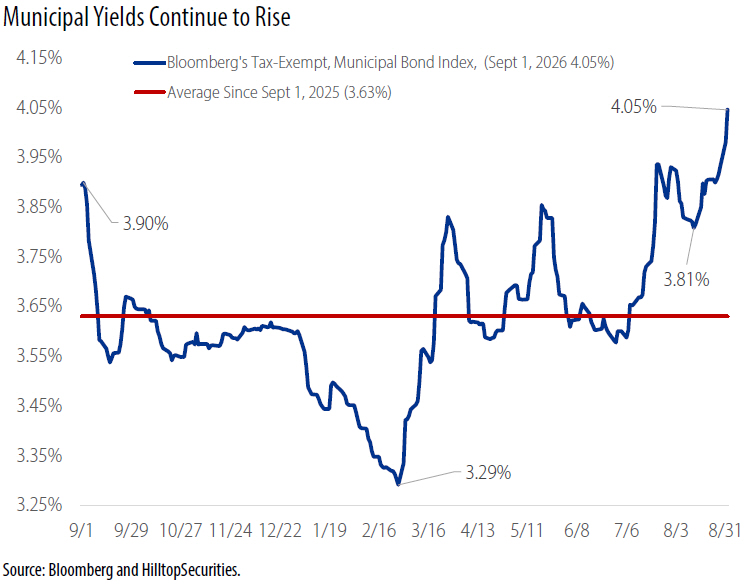
Tax-exempt yields are rising amid another global repricing of risk. The Bloomberg Tax-Exempt Municipal Bond Index ended Tuesday at 4.05%, its highest level since July 2025 and well above its 3.63% average over the past year. The index has climbed from 3.29% in February and 3.81% in early August. The increases reflect forces largely outside public finance, not broad municipal credit deterioration. Credit selection remains important, especially among K-12 school districts, health care providers, and higher education institutions.
Investors continue to respond to higher yields. Another $1.4 billion flowed into municipal institutional funds last week, according to Lipper, bringing net inflows this year to nearly $40 billion. That already exceeds the roughly $25 billion recorded during all of last year. As we wrote in May, investors remain attracted to tax-exempt income, broadly stable credit, and yields rarely available during the past two decades.
Those yields also raise financing costs for state and local governments and other public entities. Growing federal debt and the resulting competition for capital could further increase the cost of financing infrastructure and other public priorities.
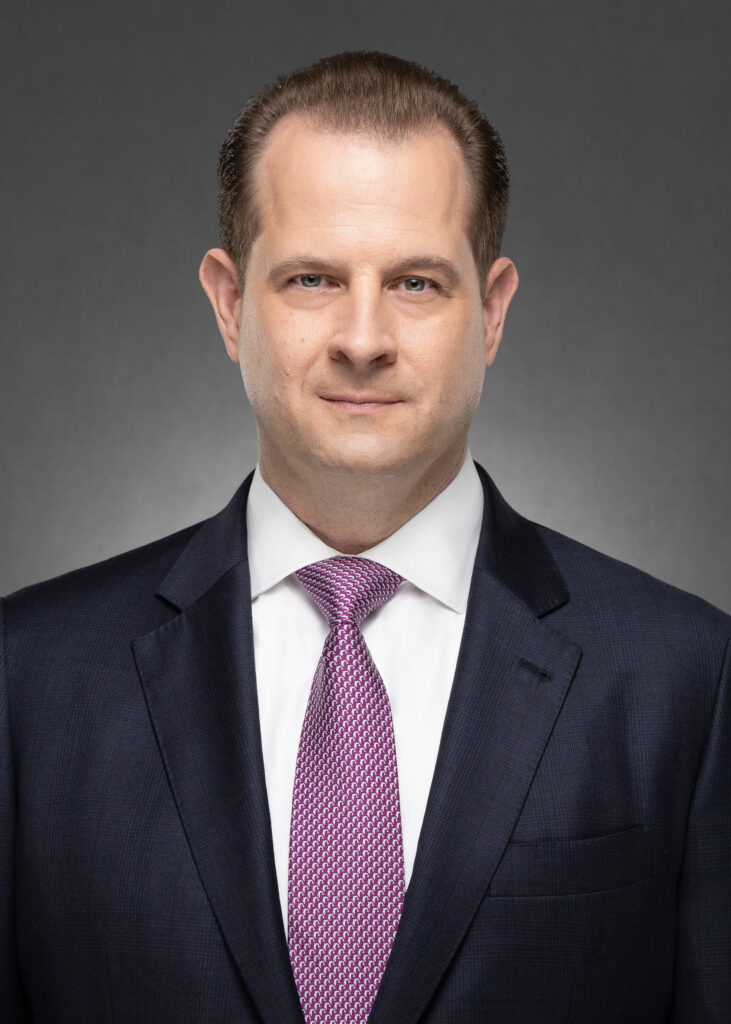 As Head of Public Policy and Municipal Strategy, Tom Kozlik advises HilltopSecurities’ businesses and clients on strategies related to U.S. public policy, public finance, and infrastructure. He publishes regular commentary that provides insight into current trends affecting these themes across a variety of sectors and geographic regions. Kozlik is frequently featured in print, digital, and broadcast news segments and regularly offers his expertise as a keynote speaker and panelist at industry conferences and events across the country. He can be reached at 214.859.9439 or tom.kozlik@hilltopsecurities.com.
The paper/commentary was prepared by HilltopSecurities (HTS). It is intended for informational purposes only and does not constitute legal or investment advice, nor is it an offer or a solicitation of an offer to buy or sell any investment or other specific product. Information provided in this paper was obtained from sources that are believed to be reliable; however, it is not guaranteed to be correct, complete, or current, and is not intended to imply or establish standards of care applicable to any attorney or advisor in any particular circumstances. The statements within constitute the views of HTS Public Finance as of the date of the document and may differ from the views of other divisions/departments of Hilltop Securities Inc. In addition, the views are subject to change without notice. This paper represents historical information only and is not an indication of future performance. This material has not been prepared in accordance with the guidelines or requirements to promote investment research, it is not a research report and is not intended as such. Sources available upon request.
Hilltop Securities Inc. is a registered broker-dealer, registered investment adviser and municipal advisor firm that does not provide tax or legal advice. HTS is a wholly owned subsidiary of Hilltop Holdings, Inc. (NYSE: HTH) located at 717 N. Harwood St., Suite 3400, Dallas, Texas 75201, (214) 859-1800, 833-4HILLTOP.