

click below to login to your secure account
By
Tom Kozlik
Head of Public Policy and Municipal Strategy
Hilltop Securities Inc.
Much of last week’s data suggests the U.S. economy has more momentum than the September nonfarm payroll report indicates. But that strength is uneven, with economic activity varying across regions and sectors. A stronger national economy does not necessarily translate into stronger conditions for every state, local government, or public-sector credit. It tells us that the stronger than expected economy is offering less support to the public sector as a whole, again reinforcing the importance of credit selection when allocating investment dollars to U.S. municipal bonds. A choice we are still in favor of because of the recent highs municipal yields have reached and because of still attractive relative value.
The upward revision to U.S. gross domestic product (GDP) growth, which we think was the most important economic data point last week, showed that the economy continued to grow at a rapid pace in the second quarter of 2026. At the same time, weaker-than-expected September nonfarm payroll growth showed that stronger economic activity is not necessarily translating into broad-based hiring across regions and sectors.
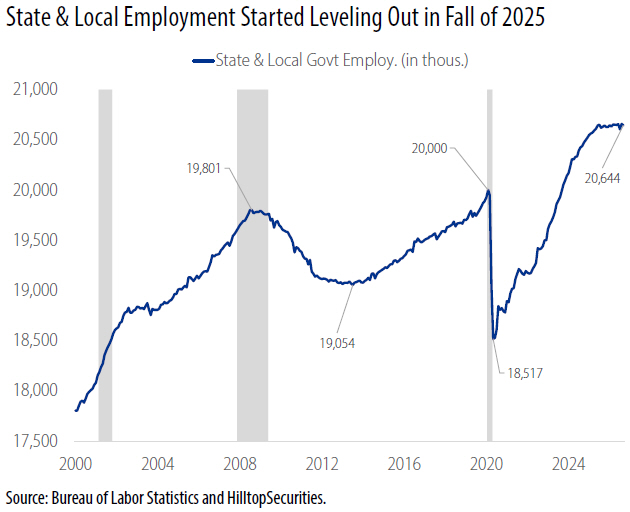
Public-sector employment is providing less of the stabilizing support that it has during past economic cycles. Federal employment has fallen sharply, while state and local government employment began leveling out in fall 2025 and has shown little growth since.
None of this suggests that the broader economy is approaching recession, nor does it change our generally constructive view of municipal credit quality. Public entities, however, are still grappling with the Post-Golden Age Realignment. Slower hiring, declining federal employment, and the leveling out of state and local government payrolls point toward greater variation in economic and credit outcomes among public-sector entities. That makes issuer and sector selection increasingly important, a point that we have been making for much of 2026, but it is worth repeating again because of last week’s data.
The weaker-than-expected September nonfarm payroll report also reduced expectations for additional Federal Reserve tightening at the Oct. 28 meeting. Fed funds futures placed the probability of another increase in the federal funds target rate at approximately 24% as of the afternoon of Monday, Oct. 5.
Municipal yields ended last week well below the highs reached earlier in the week. The Bloomberg Municipal Bond Index yield, for example, ended the week at 4.63%, down 23 basis points from Tuesday’s peak of 4.86%. The move was significant, but yields remain historically attractive. The Bloomberg Muni Index yield of 4.63% remains among its highest levels of the past several decades and municipals generally remain inexpensive relative to U.S. Treasuries.
The municipal bond opportunity may have been at its most attractive point near the beginning to middle of last week, before yields moved sharply lower. Even after that rally, however, municipal yields remain attractive, as do Municipal-to-Treasury ratios (M/T ratios), although relative value is somewhat less compelling than it was at last week’s peak.
Market and macroeconomic noise may persist, but the attractive entry point for municipal investors remains intact.
 As Head of Public Policy and Municipal Strategy, Tom Kozlik advises HilltopSecurities’ businesses and clients on strategies related to U.S. public policy, public finance, and infrastructure. He publishes regular commentary that provides insight into current trends affecting these themes across a variety of sectors and geographic regions. Kozlik is frequently featured in print, digital, and broadcast news segments and regularly offers his expertise as a keynote speaker and panelist at industry conferences and events across the country. He can be reached at 214.859.9439 or tom.kozlik@hilltopsecurities.com.
The paper/commentary was prepared by HilltopSecurities (HTS). It is intended for informational purposes only and does not constitute legal or investment advice, nor is it an offer or a solicitation of an offer to buy or sell any investment or other specific product. Information provided in this paper was obtained from sources that are believed to be reliable; however, it is not guaranteed to be correct, complete, or current, and is not intended to imply or establish standards of care applicable to any attorney or advisor in any particular circumstances. The statements within constitute the views of HTS Public Finance as of the date of the document and may differ from the views of other divisions/departments of Hilltop Securities Inc. In addition, the views are subject to change without notice. This paper represents historical information only and is not an indication of future performance. This material has not been prepared in accordance with the guidelines or requirements to promote investment research, it is not a research report and is not intended as such. Sources available upon request.
Hilltop Securities Inc. is a registered broker-dealer, registered investment adviser and municipal advisor firm that does not provide tax or legal advice. HTS is a wholly owned subsidiary of Hilltop Holdings, Inc. (NYSE: HTH) located at 717 N. Harwood St., Suite 3400, Dallas, Texas 75201, (214) 859-1800, 833-4HILLTOP.